Updated 12 November 2026: added due-diligence tables for six networks (licences, who holds funds, pricing, proof of payment), public prices by corridor, Ripple, dLocal and five specialist payout APIs.
Seven large payment companies now let a business hold or fund with stablecoins and pay a supplier, seller or contractor in local currency. Only part of what they announced works today, and the gap between the press release and the developer docs is where most buying mistakes happen.
This comparison of stablecoin payout providers covers BVNK with Mastercard Move, Visa Direct, Stripe with Bridge, Circle Payments Network, Nium, Ripple and dLocal, plus five specialist APIs, three of which publish prices. For each we answer the questions a bank or payment company asks before signing: who contracts with you, under which licence, who holds the money, what it costs, how fast it lands and what proof you get. Almost every answer comes from the companies' own docs, pricing pages and licence registers, checked on 12 November 2026; where we rely on an earnings call or an archived page, we say so.
Key moments
In short
- Circle, Nium and Ripple document stablecoin-funded payouts to bank accounts as available today. BVNK does so for USD, EUR and GBP, Stripe only in a US preview, and Visa through one processor with no published corridor list.
- Only Stripe publishes per-payout prices among the large networks: $2.50 per local payout, FX of 0.5% or 1%. Everyone else quotes per client.
- Only Nium says stablecoin-funded payouts can land on cards. None of the seven documents Apple Pay or Google Pay as a destination.
- For an EU business, check the contracting entity first: BVNK, Ripple and Bridge hold MiCA CASP authorisations; Circle's French entity offers custody and transfers under an e-money licence; Nium has no MiCA licence.
Which networks pay out stablecoins to local bank accounts?#
The question a platform or PSP asks is simple: if we hold USDC, can we pay a creator in Mexico or a supplier in the Philippines in pesos, to a normal bank account, through one contract? Seven large networks now say yes. Their readiness differs a lot.
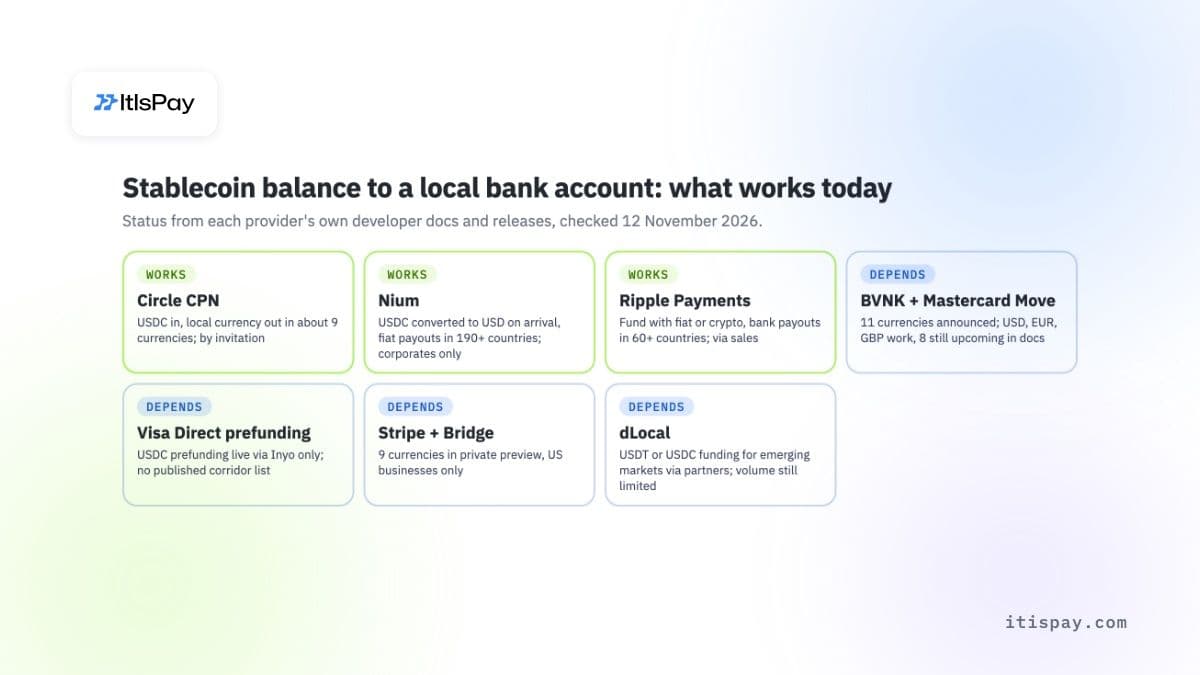
| Route | You hold or fund with | Local currencies for stablecoin-funded payouts | Who can sign up | Public pricing | Status |
|---|---|---|---|---|---|
| BVNK + Mastercard Move | USD, EUR, GBP, stablecoins in one account | 11 announced; USD, EUR, GBP working, 8 marked upcoming | Businesses and platforms, direct or embedded | Quote per client | Partly |
| Visa Direct prefunding | USDC | No list; "varies by eligibility and geography" | Through a Visa Direct processor (Inyo first) | Not published | Partly |
| Stripe + Bridge | USDC or OUSD balance | 9 currencies, 29 countries | US businesses only, private preview | Yes | Depends |
| Circle CPN Managed Payments | USDC | About 9 local currencies, the rest as USD wire | By invitation | Not published; a quote locks rate and fee | Works |
| Nium | USDC, converted to USD on arrival | 190+ countries via its fiat network | Corporates from US, EU, UK, Singapore, Canada | Flat conversion fee, amount not published | Works |
| Ripple Payments | Fiat or crypto from an approved wallet | 60+ countries, no public list | Contract with Ripple | Through sales | Works |
| dLocal | USDT or USDC | Emerging markets, via licensed partners | Contract with dLocal | Not published | Depends |
"Partly" means the product is announced and some of it runs. "Depends" means it works for a narrow group or region. Status reflects the companies' own documentation, not their marketing pages.
How do BVNK and Mastercard Move pay local bank accounts?#
Mastercard completed its purchase of BVNK on 3 August 2026, paying $1.4bn in cash plus up to $300m more if targets are met, according to its third-quarter 10-Q. The first joint product, Mastercard Global Money Platform, launched on 15 October 2026. It gives banks, fintechs and enterprises one account for fiat and stablecoins and one API.
On 11 November 2026 BVNK announced local bank payouts from stablecoin balances through Mastercard Move. The flow has three steps:
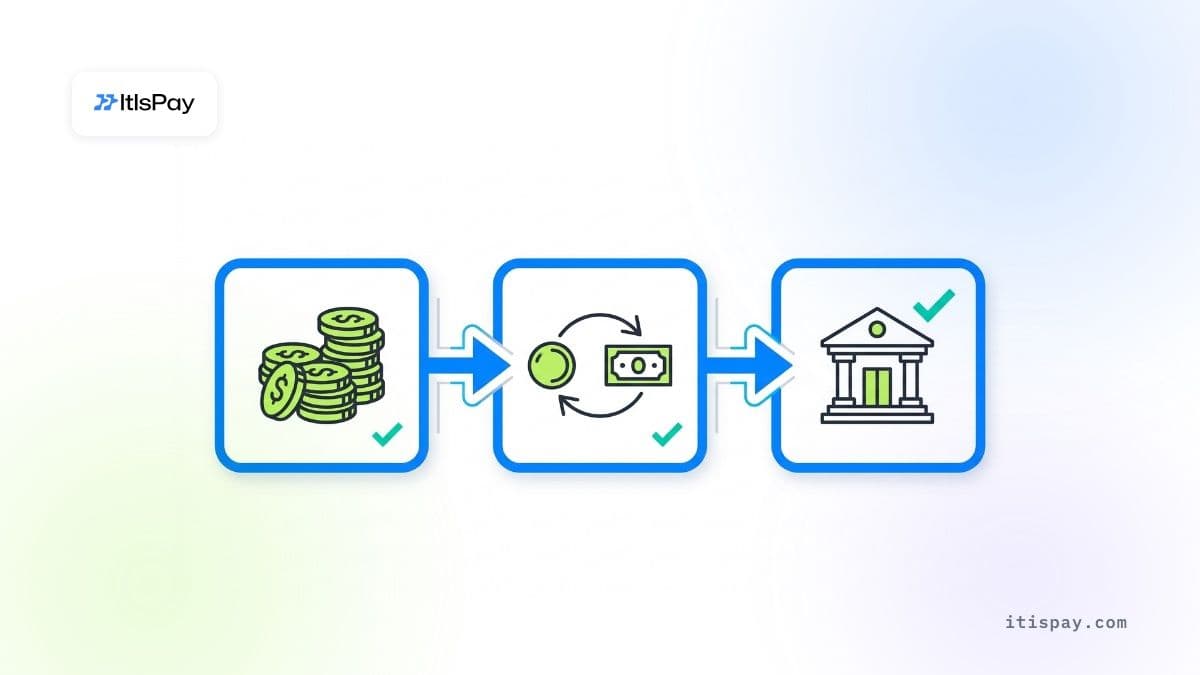
- You hold USD, EUR, GBP or stablecoins in one account.
- You start a payout by API or in the portal. BVNK converts the stablecoin and routes the fiat payment through Mastercard's network.
- The money lands in the recipient's local bank account on domestic rails.
The launch list has 11 currencies: MXN, BRL, ARS, COP, CLP, USD, CAD, PHP, KRW, GBP and EUR. BVNK plans more than 40 currencies across 200-plus countries and territories during 2027. Payouts work both for your own business and for your customers, if you embed BVNK accounts in your product and add your own markup.
Read the docs before you plan corridors. On 12 November BVNK's payment-methods page still said of the eight non-USD, EUR and GBP currencies: "Payouts in these currencies are upcoming and not available yet." Once live, payouts in BRL, MXN, ARS and CAD will be capped at USD 100,000 per business payout and USD 25,000 per payout to an individual. The working rails today are SEPA Instant and Faster Payments around the clock, plus SEPA, ACH, Fedwire, FedNow, RTP and SWIFT.
One number to treat with care is "17 billion endpoints". That is the reach of Mastercard Move as a whole (accounts, cards, wallets and cash pickup, as of October 2025), not of the stablecoin route. Through BVNK, only bank accounts are offered so far. Push-to-card and mobile wallets are described as future capabilities, with no date.
BVNK publishes no fee numbers. Its EU disclosure describes the structure instead: the BVNK rate plus an agreed margin, percentage and/or fixed payment fees that can be tiered by volume, and optional onboarding, platform and minimum monthly fees. A dry-run endpoint shows the rate and fee before you pay. BVNK reports $30bn in annualised processing volume for 2025, without a split by product.
What does Visa Direct stablecoin prefunding change?#
Visa Direct prefunding lets a business fund its payouts with stablecoins instead of a fiat deposit. The recipient is still paid in local currency. Visa announced the pilot on 30 September 2025, and on 15 October 2026 moved it into commercial production with USDC. The first and so far only live enabler is Inyo Global, a Visa Direct processor.
Four things limit how far you can plan on it today:
- You cannot buy it from Visa. Visa Direct clients must be a licensed Visa acquirer or a regulated money transfer operator, so an ordinary business signs with an enabler.
- Inyo contracts through US entities such as Golden Money Transfer Inc. Its own FAQ, last updated in January 2025, says EU and UK licences are "under application", and its stablecoin page claims an EU/EEA e-money licence without naming the entity, so an EU or UK business has no named Inyo entity to sign with.
- Visa publishes no country or currency list for the stablecoin-funded flow: "Availability varies by eligibility and geography." Inyo lists 68 corridors it has validated end to end; Uzbekistan, for example, is card-only.
- zerohash, which holds a Dutch MiCA CASP authorisation and a New York BitLicense, was announced as a second enabler on 5 August 2026 but is not confirmed live.
Visa Direct itself is very large: more than 18 billion cards, accounts and wallets, and about $1.5 trillion across more than 15 billion transactions in fiscal 2026, according to Visa's 27 October earnings call. Do not confuse that with Visa's stablecoin settlement figure ($25bn+ annualised), which measures settlement between Visa and card issuers and acquirers, not business payouts. No price has been published by Visa, Inyo or zerohash.
Can you pay out from a Stripe stablecoin balance?#
Yes, if you are a US business and Stripe lets you into the preview. Sending from a stablecoin balance to a recipient's bank account in local currency is in private preview for US businesses only. Bridge, which Stripe bought in February 2025, holds the USDC and OUSD; US dollar balances sit with Fifth Third Bank.
The bank route covers nine currencies (ARS, BRL, COP, EUR, GBP, MXN, NGN, PHP, USD) and 29 countries. Only USD, EUR and MXN carry no preview label. The exchange rate is not locked in advance, so the amount can move before it lands.
Stripe is the only large network with public prices, though they sit in its general Global Payouts table, not on a separate stablecoin line. Local-rail payouts outside the UK, Canada, Australia and EU cost $2.50, SWIFT $25, a debit card 0.75% plus $1.50, and stablecoins to a crypto wallet $0.50 plus 0.5%. Currency conversion costs 0.5% for 20 major currencies, including EUR, GBP and MXN, and 1% for the other 135, including BRL, COP, ARS, NGN and PHP. The first 50 domestic payouts a month are free, and a 0.05% platform fee applies above $1m a month.
For an EU business this route is mostly closed. Stripe's stablecoin payouts are for US businesses, Global Payouts can send from the US and UK only, with 21 EU countries and Australia limited to a private preview, and Bridge, despite its Luxembourg CASP and e-money licences from June 2026, states for its MXN, BRL, GBP and COP routes: "EU customers are not currently supported."
How does Circle Payments Network pay in local currency?#
Circle's CPN Managed Payments, launched on 8 April 2026, is the most straightforward of the large networks. You hold USDC in a Managed Payments account. Circle acts as the sending institution, and a partner institution in the destination country pays local currency into the recipient's bank account. A quote locks the exchange rate and the fee before you send. Joining is by invitation.
Circle's payment-methods table lists 17 destinations. About nine receive local currency on local rails, including BRL by PIX, MXN by SPEI, INR, HKD, SGD, COP and NGN; the rest receive USD by wire. Instant rails such as PIX, SPEI and India's IMPS typically settle in about five minutes, Singapore in about 30 minutes, wires in one to two business days.
Circle names the parts of the price but not the numbers: the receiving institution's fee including its FX spread, a CPN network fee in basis points by country group, tax and gas. Its Circle Mint schedule is public: since 19 October 2026 standard USDC redemption is free and express redemption costs 5 basis points, and Circle says express fees do not apply to CPN activity.
The network is growing fast. Circle reported $41bn in annualised CPN volume at the end of the third quarter and more than $58bn by 30 October 2026, with 205 enrolled financial institutions. That is all network volume, not only payouts to bank accounts. Circle has also agreed to buy Tazapay, which adds payout rails in more than 100 markets once the deal closes, expected in 2027.
Why do Nium, Ripple and dLocal belong on the list?#
Nium does not convert stablecoins into local currency directly. It takes USDC as funding through Circle, converts it to US dollars on arrival and pays out through its existing fiat network. In its own words: "You fund in USDC, we convert it to USD, and your payout lands in local currency in 190+ countries." It went live on 27 August 2026 for eligible corporate clients from the US, EU, UK, Singapore and Canada, and "Nium does not hold USDC". There is one flat conversion fee; Nium does not publish the amount. In the EU, Nium operates as an e-money institution licensed in Lithuania and holds no MiCA CASP licence.
Ripple Payments lets a business fund with fiat or crypto from a wallet Ripple has approved (it does not list which crypto assets it accepts), then pay bank accounts in 60+ countries. Its docs give limits per rail: PIX and SPEI around the clock, SEPA Instant up to €100,000, Faster Payments up to £1m, and in the US RTP up to $5m and ACH up to $1m. In the EU it contracts through Ripple Payments Europe S.A., authorised as a MiCA CASP by Luxembourg's CSSF on 29 June 2026. Prices come only through sales.
dLocal lets you fund in USDT or USDC and pay out in local currency across emerging markets, with the crypto leg run by licensed partners such as Circle and BVNK. One live example is Félix, which pays from the US into bank accounts in Mexico, Guatemala and Honduras. On its Q4 2025 earnings call in March 2026, dLocal's management called the contribution of stablecoins to its volume limited so far, and it publishes no prices. Thunes funds payouts in USDC and EURC as well, but only for members of its network, so it is not a route for an ordinary business.
What should a bank ask a stablecoin payout provider?#
Banks and payment companies ask the same questions before they add a payout rail: who signs, under which licence, where the money sits, what it costs and what proof comes back for compliance or currency control. Here is what each network discloses publicly. Anything not shown is available only from sales, usually after an NDA.
| Provider | Who contracts in the EU | US entity | Who holds funds |
|---|---|---|---|
| BVNK | System Pay Services (Malta), MiCA CASP from the MFSA, 13 Feb 2026 | System Pay Services (US), money transmitter | Fiat with partner banks; Lead Bank and Cross River named as US partners |
| Visa Direct via Inyo | No named EU entity | Golden Money Transfer Inc. | Visa Payments Limited receives payout funds; who holds the USDC is not published |
| Stripe + Bridge | Bridge Building S.A., Luxembourg CASP and e-money licences | Stripe Payments Company (53 US jurisdictions); Bridge Building Inc. (33 US jurisdictions) | Bridge holds stablecoins; Fifth Third Bank holds US dollars |
| Circle CPN | Managed Payments is run by the US entity; Circle Internet Financial Europe SAS holds a French e-money licence and MiCA custody and transfers | Circle Internet Financial, LLC | Circle holds prefunded USDC in regulated custody; reserves segregated, mostly in a BlackRock-managed fund |
| Nium | UAB Nium EU, e-money licence, Bank of Lithuania | Nium, Inc., 36 state licences | Converts USDC to USD at once; US funds at CFSB or Cross River |
| Ripple | Ripple Payments Europe S.A., MiCA CASP from the CSSF | Ripple Markets DE LLC | Ripple-managed account; safeguarding banks not published |
| Provider | Published price | Proof of payment | Embed or resell |
|---|---|---|---|
| BVNK | Fee structure only | Payout record names the beneficiary; PDF proof for completed fiat payouts, with bank trace reference | Embedded model with your own markup |
| Visa Direct via Inyo | None | End-to-end ID and return reason codes | Through the enabler |
| Stripe + Bridge | Yes, general payout table | Rail reference numbers | Bridge is built for embedding; you set your own fee |
| Circle CPN | Fee components named; Mint fees public | Sender name and reference on the statement where the rail allows; daily CAMT.053 | White-label resale allowed; terms not public |
| Nium | Fee type only: one flat conversion fee | Payout record names the beneficiary; SWIFT gpi tracking; pacs.008 on request in some corridors | API embedding, referral and resale tracks |
| Ripple | None | Payment record carries beneficiary identity; no confirmation document described | "On behalf of" flows for your customers, by contract |
Two policies stand out for cross-border flows. BVNK's financial-crime policy bans payments that "appear to circumvent currency controls" and chains where your customer's customer pays through you. Circle lets the receiving institution ask for the underlying invoice and ownership documents, and an unanswered request cancels the payment. Plan your compliance file around both before the first payout.
How much do stablecoin payouts cost by corridor?#
Most networks will not give you a number until you talk to sales, so the only public benchmarks come from Stripe and from specialist APIs. Use them as a floor for negotiation, not as a quote.
| Provider | What you pay | Example |
|---|---|---|
| Stripe | $2.50 per local payout, FX 0.5% or 1% | Paying MXN: $2.50 plus 0.5% FX; paying BRL: $2.50 plus 1% |
| Circle Mint | Standard redemption free, express 5 bps | Express fee not charged on CPN activity |
| BlindPay | $399 or $1,599 a month, billed annually | Per-transfer fee shown in each quote |
| Conduit | $35 flat on transfers below $10,000 | US transfers in up to 2 hours, weekdays |
| Yellow Card (archived) | Per-country rate card, 20 African markets | Nigeria bank transfer: NGN 100 flat |
Yellow Card's rate card, updated on 24 March 2026, is no longer online; the figures come from an archived copy of April 2026. It priced Kenya mobile money at 1.5% and South African bank transfers at 0.25% for amounts up to ZAR 60,000. Treat it as an indication of how African corridors are priced, then ask for a current quote.
Which specialist stablecoin payout APIs publish prices?#
Below the large networks sits a layer of specialist APIs, built only for stablecoin payouts. They often move faster and publish more, but most serve one region or US clients.
- BlindPay is registered with FinCEN as a money services business and publishes plans of $399 and $1,599 a month, billed annually. Its docs also say there is no setup fee and no monthly minimum, so confirm which applies to you. Business limits are $30,000 per transfer, $100,000 a day and $250,000 a month.
- Conduit charges a flat $35 on transfers below $10,000 and settles US transfers in up to two hours on weekdays, which suits treasury flows more than mass payouts.
- Yellow Card covers 20 African markets with bank and mobile-money payouts and holds full licences in South Africa and Botswana.
- Bitso Business runs through regulated Nvio entities in Mexico, Brazil and Argentina, and in Colombia under a regulatory sandbox, without public prices.
- Due holds a MiCA CASP authorisation from Spain's CNMV since 12 June 2026, but only for exchange services, not custody or transfers.
Can stablecoin payouts reach cards, Apple Pay or Google Pay?#
Only Nium says stablecoin-funded payouts can reach cards, and none of the seven documents Apple Pay or Google Pay. Bank accounts are the only endpoint all of them support.
| Endpoint | BVNK + Move | Visa Direct prefunding | Stripe + Bridge | Circle CPN | Nium |
|---|---|---|---|---|---|
| Local bank account | Yes | Not listed | Partly | Yes | Yes |
| Stablecoin wallet | Yes | Fiat-funded pilot | Partly | Yes | Yes |
| Debit card | No | Not listed | Not available | No | Yes |
| Apple Pay or Google Pay | No | Not available | Not available | No | Not available |
"Partly" marks a preview or pilot. "Not available" means the provider does not document it for the stablecoin-funded flow. Visa does not list endpoint types for prefunded payouts; prefunding pays for ordinary Visa Direct payouts. Nium says stablecoin-funded payouts land in bank accounts, wallets or cards, and it pays out in USDC through Coinbase.
Apple Pay and Google Pay are not accounts you can pay into. A payout "to Apple Pay" is a push to a debit card saved in the wallet, carried by Visa Direct or Mastercard Send, and the money lands at the bank that issued the card. Stripe offers this in a US-only preview for fiat payouts and rejects Apple Cash cards. If card payouts matter for your recipients, check Nium or a fiat payout product for that leg today, and watch BVNK's card and wallet roadmap.
Which stablecoin payout route works for an EU business?#
For a business based in the EU, the shortlist is shorter than the headlines suggest. Two checks matter: can you sign up from the EU, and which entity holds the licence for the crypto leg.
- BVNK contracts through a Maltese company with a MiCA CASP authorisation and serves businesses and their customers.
- Ripple contracts through a Luxembourg company with a MiCA CASP authorisation from June 2026.
- Circle's French entity holds an e-money licence and offers custody and transfers under MiCA; the US company runs Managed Payments.
- Nium accepts EU corporates for USDC funding under a Lithuanian e-money licence, without a MiCA CASP licence.
- Stripe's stablecoin payouts are US-only today, and Visa Direct prefunding has no EU-licensed enabler confirmed live.
Where these routes do not help yet
- Paying Apple Pay or Google Pay from stablecoins: no documented route among the seven. For cards, only Nium.
- Planning on BVNK's 11 currencies today: eight were still "upcoming" in its docs on 12 November 2026.
- Budgeting costs: only Stripe publishes per-payout prices among the large networks.
- Corridors outside the published lists, such as much of Africa and the Middle East: BVNK, Circle and Stripe mostly offer USD by wire or nothing; Nium's fiat network and African specialists are the main exceptions.
- Flows that touch currency controls: BVNK's policy bans payments that appear to circumvent them, so document the trade behind each payout.
How to choose a payout route for your corridors#
Start from your recipients, not from the network. List where you pay, in which currency, to which endpoint (bank, card, wallet) and whether the recipient is a business or a person. Then match each line against the documented coverage, not the press release.
- Check each corridor in the provider's developer docs, which are updated more often than marketing pages.
- Send every shortlisted provider the same questions: contracting entity and licence in your region, where your funds sit and with which bank, per-payout fee and FX margin by corridor at your monthly volume, time to credit, what the payout confirmation shows about the beneficiary, and whether you may embed or resell the service.
- Ask for a quote on your three biggest corridors and compare the all-in cost: conversion, payout fee and FX spread.
- Keep a fallback route per corridor. At this stage of the market, a corridor that is "upcoming" in one network may already be live in another.
Most platforms will end up using more than one route: one network for Latin America, another for Asia, a specialist for Africa and a fiat product for cards.
For providers listed here: every fact comes from your public docs, pricing pages and licence registers as of the date above. If something is out of date, write to [email protected] and we will correct it within two business days.
If you want to add a stablecoin payout rail, book a 20-minute corridor check and bring your list of countries, currencies, endpoints and monthly volume. ItisPay provides the API, invoicing and reconciliation, with settlement to EUR through our EU-licensed CASP + Payment Institution partner. On the call we map which of the routes above covers each of your corridors, and where ours does not, we tell you which network does.
This article is for informational purposes only and does not constitute legal or regulatory advice.