An EU EMI license, also called an e-money license (authorisation as an electronic money institution), costs at least €350,000 in initial capital before you pay a single regulator fee. The law gives the regulator three months to decide once your file is complete, but the median wait across Europe is now 9.5 months, and Ireland's central bank warns that assembling a complete file can take over a year.
Fees differ more than most guides admit: from nothing in Ireland to about €30,000 in Luxembourg. They still matter less than the capital, the team and the time. Two more things shape the decision in 2026. PSD3 will fold e-money institutions into a single payment-institution regime, and an EMI license still does not let you offer crypto services beyond the e-money tokens you issue yourself.
In short
- An EMI license requires at least €350,000 of initial capital, then own funds of at least 2% of average outstanding e-money (EMD2 Art. 4 and 5).
- Application fees run from €0 in Ireland to €10,000–15,000 in Malta and about €30,000 in Luxembourg; Malta adds an annual fee from €25,000.
- The legal deadline is three months from a complete file; the EBA puts the real median at 9.5 months (December 2025).
- PSD3 will repeal the E-Money Directive, and an EMI license does not cover crypto-asset services beyond the e-money tokens you issue.
What does an EMI license let you do?#
An EMI license lets a company issue electronic money: stored value that a customer pays for in advance and can spend or redeem later. That is the right to hold customer balances in your own product, which a payment institution does not have. EMIs may also provide payment services, grant credit linked to payments (not funded from e-money) and run payment systems, under Article 6 of the E-Money Directive (2009/110/EC), known as EMD2.
There are firm limits. An EMI may not take deposits. It must issue e-money at par and redeem it at par at any moment, and it may not pay interest or any other benefit tied to how long a customer holds the balance (EMD2 Art. 6(2), 11 and 12).
Once authorised in one member state, the license is valid across the EU through passporting (PSD2 Art. 11(9)).
| EMI | Payment institution | |
|---|---|---|
| Initial capital | €350,000 | €20,000, €50,000 or €125,000 by service |
| Issue e-money and keep client balances | Yes | No |
| Payment services (transfers, acquiring, accounts) | Yes | Yes |
| Take deposits, pay interest | No | No |
| EU passport | Yes | Yes |
| Crypto-asset services | Partly, own e-money tokens only | No |
The payment-institution capital tiers come from PSD2 Art. 7: €20,000 for money remittance only, €50,000 for payment initiation, €125,000 for the core services.
How much does an EMI license cost?#
The real cost has three layers: capital you must hold, fees you pay the regulator, and the team and systems the regulator expects to see working. Only the first two have published numbers.
Capital and own funds#
EMD2 Art. 4 requires initial capital of "not less than EUR 350 000" at the time of authorisation. This is your money, held in the company, not a fee. After that, own funds must stay above the higher of €350,000 or 2% of average outstanding e-money (Art. 5(1) and 5(3)). A firm with €50 million of customer balances on average therefore needs at least €1 million of own funds.
Two details push the number up. If you also provide payment services not linked to e-money, the requirement for those is added on top (Art. 5(2)). And the regulator may set own funds up to 20% higher, or lower, after assessing your risk management (Art. 5(5)).
Regulator fees#
One-off application fees in 2026 range from €0 in Ireland to about €30,000 in Luxembourg (country table below). Annual supervision fees vary more. Malta charges €25,000 a year for an e-money-only institution and €35,000 for e-money plus payment services, plus a variable part based on assets or outstanding e-money, under its fee regulations as amended in 2024. The Netherlands charges a fixed amount plus a share of commission income.
The costs no regulator publishes#
Regulators do not publish what a compliance officer, a money-laundering reporting officer (MLRO), external audit, a safeguarding bank account or the payment platform will cost you. These depend on country, salaries and how much you build in-house. They are also where most first-year money goes: managers, a board, an AML function and audited accounts are needed before the first customer pays. Ask for written quotes before you choose a country. A cheap application fee in a market where you must hire senior local staff can end up costing more than a higher fee elsewhere.
Which EU country is cheapest and fastest for an EMI?#
Fees are small next to the €350,000 floor. What separates countries is how much work happens before the official clock starts: pre-application meetings, exploratory stages and the degree of scrutiny. The EBA's December 2025 follow-up review found "significant differences persist in key areas such as governance, internal control mechanisms, and local substance". In the table below, the Verdict column says whether the regulator's published process points to a quick, predictable answer.
| Country | Regulator | Application fee | Before you file | Verdict |
|---|---|---|---|---|
| Ireland | Central Bank of Ireland | €0 | Mandatory pre-application meeting | No |
| Malta | MFSA | €10,000 or €15,000 | Pre-application meeting | Depends |
| Netherlands | DNB | €10,400 | Fee set yearly in the Staatscourant | Depends |
| Luxembourg | CSSF | €30,000 | Initial meeting on the project | Depends |
| Latvia | Latvijas Banka | €5,000 | Completeness check, 15 working days | Partly |
| Cyprus | Central Bank of Cyprus | €10,000 + €5,000 pre-stage | Paid exploratory stage since August 2026 | Depends |
Sources: Central Bank of Ireland authorisation page; Maltese S.L. 376.03 as amended by L.N. 366 of 2024; Dutch Staatscourant 2026 nr. 20792; Latvijas Banka licensing page (all checked 3 November 2026). Luxembourg: the 2023 fee regulation as summarised by law firm Lexgo. Cyprus: Cyprus Mail, 31 July 2026.
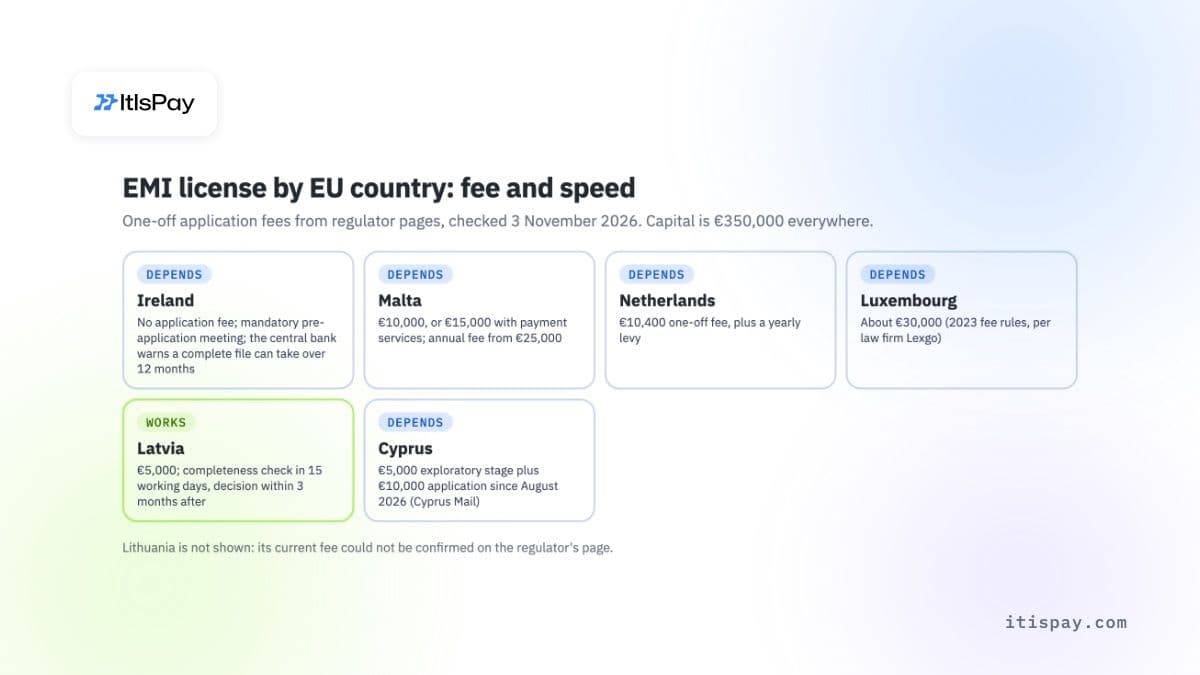
A few points the table cannot show. The Central Bank of Ireland charges nothing to apply but bills an annual industry funding levy once you are authorised. Malta's law treats a decision not taken within three months of a complete application as a refusal, and the MFSA starts that clock only from a formal and complete application. Latvijas Banka promises a decision within three months after it confirms the file is complete. Cyprus tightened its process from 3 August 2026: a €5,000 non-refundable exploratory stage, a formal application fee raised from €5,000 to €10,000, and possible due diligence by an expert firm, according to Cyprus Mail.
Lithuania remains a common choice for EMIs. We left it out of the table because we could not confirm the Bank of Lithuania's current fee on its own page at the time of writing.
How long does it take to get an EMI license?#
Plan for at least a year from your first meeting to authorisation. The three-month deadline in the law runs only once the regulator has every document it asks for.
The rule sits in PSD2 Art. 12, which applies to EMIs through EMD2: the authority must decide "within 3 months of receipt of an application or, if the application is incomplete, of all of the information required for the decision". In practice the file goes back and forth several times before it counts as complete.
The European Banking Authority measured the gap twice. Its 2023 peer review found authorisation processes "ranging from 4 to 20 months or more". In its December 2025 follow-up review, the EBA said: "The median authorisation process in the EEA (counting from submission of an application) now takes 9.5 months."
The Central Bank of Ireland is unusually direct about it on its authorisation page: "Experience suggests that it can take over 12 months for firms to provide all of the information necessary to enable a decision to be made."
Count the months before submission too. Policies, a three-year business plan, safeguarding arrangements and the hiring of key people all have to be in place before a regulator will accept the file.
What do regulators check in an EMI application?#
They check whether the business can protect customer money and stop financial crime from the first day. The file has to show a working company, not a plan to build one.
Expect scrutiny in five areas:
- The programme of operations and business plan: what you will issue, to whom, through which channels, with three-year financial projections.
- Safeguarding under EMD2 Art. 7. Funds received by card or other payment instrument must be safeguarded no later than five business days after the e-money is issued, and any material change to these arrangements must be notified in advance.
- Governance, and fit-and-proper checks on directors and qualifying shareholders.
- AML and counter-terrorist financing controls, with a named responsible person.
- Local substance: where decisions are really taken and who sits in the country. The EBA names it among the key areas where supervisors still diverge.
Distribution has its own rule. An EMI may distribute and redeem e-money through distributors, but it may not issue e-money through agents (EMD2 Art. 3(4) and 3(5)).
In Ireland the process starts with a pre-application key facts document of about 15 to 20 pages, sent at least five working days before the first meeting.
Is a small EMI registration enough?#
Only if you plan to stay in one country and small. Under EMD2 Art. 9, a member state may waive the capital, own funds and safeguarding rules for firms whose average outstanding e-money does not exceed a national limit of at most €5 million.
The price of the waiver is the passport. Waived institutions cannot provide services in other member states, and the head office must be in the country where the firm actually does business. Not every country offers the option. For a firm planning to serve customers across the EU, the small regime is at best a test run.
What changes for EMIs under PSD3?#
PSD3 ends the separate e-money regime. Council and Parliament reached a provisional agreement on PSD3 and the new Payment Services Regulation (PSR) in late November 2025. The Council's draft statement of reasons, dated 21 October 2026, says the package "repeals the Electronic Money Directive (EMD2), fully integrating electronic money institutions (EMIs) into the updated payment institutions (PI) authorisation and supervisory regime".
As of 3 November 2026 we could not find the final text in the EU's Official Journal. Until it is published, the details below come from law-firm readings of the compromise text and may still shift:
- A&L Goodbody reports that the e-money service would need at least €250,000, down from €350,000, with amounts added together for firms offering several services.
- Existing EMIs will need to be authorised again under the new regime. A&L Goodbody and Arthur Cox describe a period of up to 27 months from entry into force. The European Parliament's summary describes 30 months, provided a new application is filed within 24 months.
- The Council says the rules on protecting user funds become stricter.
If you apply now, you get an EMD2 license and then a second authorisation process under PSD3. Build that second file into your plan and budget.
Does an EMI license cover crypto and stablecoins?#
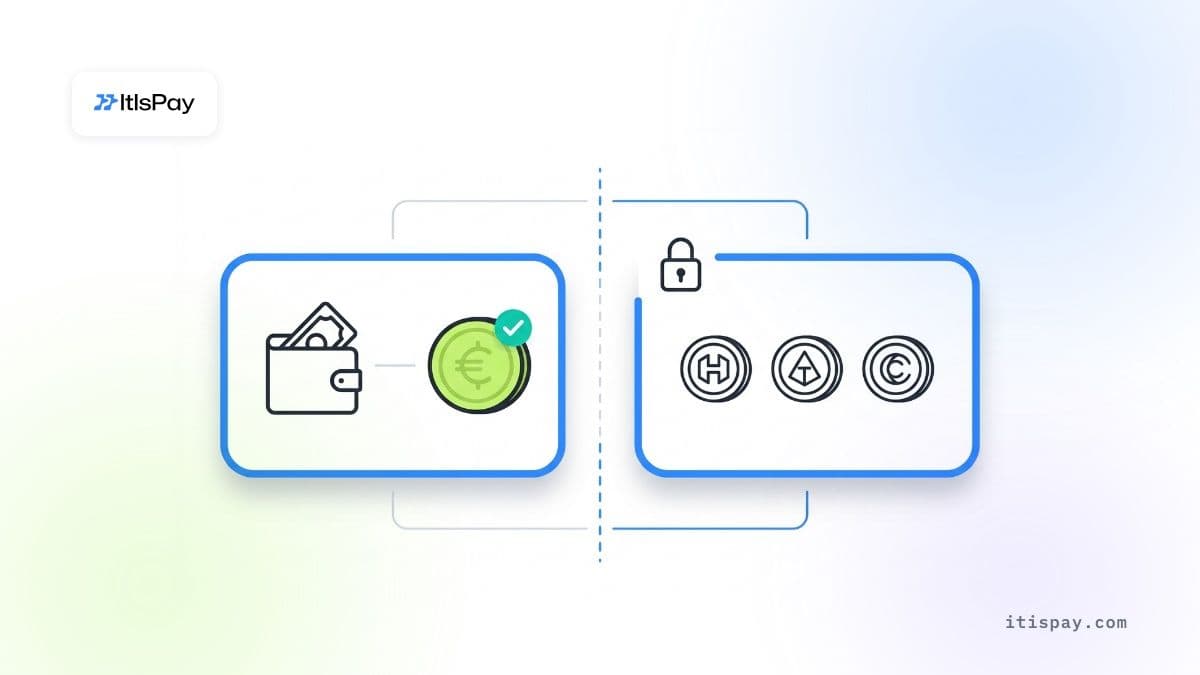
Only in a narrow way. Under MiCA (Regulation (EU) 2023/1114), an EMI may issue e-money tokens, stablecoins referencing one official currency, if it publishes a white paper and notifies its regulator at least 40 working days before the offer (Art. 48). MiCA treats e-money tokens as electronic money.
For services, Art. 60(4) is strict. An EMI "shall only provide custody and administration of crypto-assets on behalf of clients and transfer services for crypto-assets on behalf of clients with regard to the e-money tokens it issues", after notifying its regulator 40 working days in advance. Exchanging crypto for euros, holding other tokens for clients or running a trading venue requires authorisation as a crypto-asset service provider (CASP) under MiCA. Our guide to what a MiCA CASP license requires covers that process, and what a MiCA CASP license costs covers the budget.
Where an EMI license does not help
- Accepting, exchanging or holding crypto other than e-money tokens you issue yourself: that needs a CASP authorisation.
- Paying interest on balances or taking deposits: banned under EMD2.
- Serving other EU countries on a small EMI waiver: no passport.
- Avoiding a second application: PSD3 will require existing EMIs to be authorised again.
Should you get your own EMI license?#
Get one if stored customer balances are your product (wallets, prepaid cards, accounts for your users) and you can fund €350,000 of capital plus a team for a year or more before revenue. Do not get one if what you need is to accept payments, settle in euros or add crypto for your merchants: a licensed partner covers that without a license of your own.
If building your own licence and compliance team is not the right move yet, you can route through a licensed CASP + Payment Institution partner. ItisPay provides the API, invoicing and reconciliation; the partner holds the authorisation, runs KYC and settles to EUR, with under one week from KYB submission to first transaction.
This article is for informational purposes only and does not constitute legal or regulatory advice.