The best crypto payment gateway for a business that needs euros on an EU bank account is one that sits in the ESMA register, converts the crypto itself and pays out by SEPA. Of the eight gateways compared here, three hold the licence themselves (one of them without a published fee or a named euro settlement), one works through a licensed partner, and four hand you the crypto or have no EU licence. Two providers that most lists still recommend are not available to an EU merchant at all.
This crypto payment gateway comparison checks what a compliance review checks: the register row, the settlement currency, who holds the money between payment and payout, the sector rules in the terms, and the fee on the official pricing page. ItisPay is one of the rows and gets the same columns as everyone else.
In short
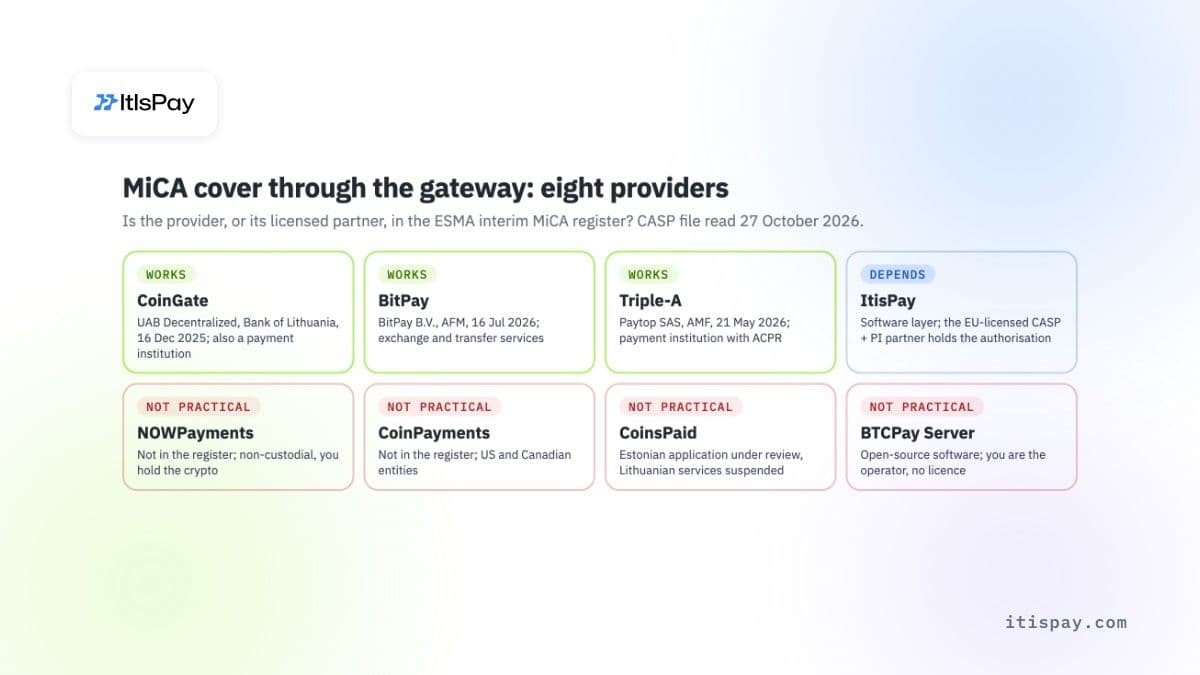
- Three of the eight gateways hold a MiCA authorisation in the ESMA interim register as of 27 October 2026: CoinGate, BitPay B.V. and Triple-A's EU entity Paytop SAS. ItisPay routes through a licensed partner. NOWPayments, CoinPayments and CoinsPaid are not in the register; BTCPay Server is software you run yourself.
- EUR to a bank account: CoinGate settles weekly with free SEPA withdrawals from 50 EUR, BitPay settles daily, Triple-A pays to a named IBAN, ItisPay settles in EUR or USD to an IBAN through its partner. NOWPayments and BTCPay Server give you crypto; converting it is your job.
- Fees on official pages: BTCPay Server 0%, CoinPayments from 0.5%, ItisPay 0.75% all-in plus a monthly fee, CoinGate and NOWPayments 1%, CoinsPaid under 1.5%, BitPay 2% + 25c below 500,000 USD a month. Triple-A does not publish a rate.
- Nobody says "yes" to iGaming in writing. BitPay and Triple-A restrict gambling, CoinGate allows it only with a valid licence, NOWPayments markets to casinos without an EU licence, ItisPay reviews each business individually.
How we compared crypto payment gateways#
The criteria are the ones a head of payments has to defend in front of a compliance officer, not coin counts or plugin lists. For each gateway we recorded five things: the fee on its own pricing page, whether it pays euros to a bank account and how often, whether the legal entity appears in the ESMA interim MiCA register, what its terms say about gambling and financial services, and who holds the funds between the customer's payment and the merchant's payout.
Sources are the providers' own pricing and terms pages and the ESMA register, all read on 27 October 2026. Vendor "top 10" lists of the best crypto payment processors were used only to see which names people search for; their fee claims disagree with the official pages in at least six cases, so none is cited here.
What is the best crypto payment gateway in 2026?#
For a licensed EU merchant that wants weekly euros with no surprises, CoinGate is the simplest fit; for daily settlement at volume, BitPay; for a PSP or a business that wants its own front end on a licensed rail, ItisPay or Triple-A. The table shows why, and the verdict answers one question: can an EU business get euros on its bank account with MiCA cover through this gateway?
| Gateway | Fee (official page, 27 Oct 2026) | EUR to bank account | MiCA status (ESMA register, 27 Oct 2026) | High-risk and iGaming | Verdict |
|---|---|---|---|---|---|
| CoinGate | 1% per transaction; SEPA withdrawal free from 50 EUR | Yes, weekly automatic settlement in EUR, GBP or USD | Authorised CASP (UAB Decentralized, Bank of Lithuania, 16 Dec 2025); also a payment institution | Licensed gambling allowed; unlicensed gambling and unregulated financial services prohibited | Works |
| BitPay | 2% + 25c under 500,000 USD a month, 1.5% + 25c to 999,999 USD, 1% + 25c above; higher for high-risk | Yes, daily settlement, Euro listed | Authorised CASP (BitPay B.V., AFM, 16 Jul 2026) for exchange and transfer services | Gambling and FX services need BitPay's express authorisation | Works |
| Triple-A | Not public | Named IBAN in local currency; EUR not named on the page | Authorised CASP (Paytop SAS, AMF, 21 May 2026); payment institution with ACPR | Gambling restricted for merchants, prohibited for PSP clients | Depends |
| ItisPay | 0.75% all-in on the entry plan, plus a monthly fee | Yes, EUR or USD to an IBAN through the EU-licensed CASP + Payment Institution partner | Not licensed itself; the partner holds the CASP and PI authorisation | Case by case, iGaming included | Works |
| NOWPayments | 1% service fee, network fees extra | Not stated; non-custodial by default, you receive crypto | Not in the register | Markets to iGaming and casinos | No |
| CoinPayments | From 0.5% on coins, 1% on tokens; higher for high-risk | To SEPA or SWIFT; conversion cost not published | Not in the register; Panamanian and US entities | No sector policy on the fee page | No |
| CoinsPaid (CryptoProcessing) | Under 1.5% | 40 fiat currencies including EUR, availability by jurisdiction | Not in the register; Estonian application under review, Lithuanian entity suspended | Sells an iGaming product | No |
| BTCPay Server | 0%, self-hosted | No built-in fiat conversion | Software, no licence; you are the operator | No provider to refuse you | No |
CoinGate#
CoinGate is a Lithuanian provider authorised as a crypto-asset service provider (CASP, the MiCA licence) by the Bank of Lithuania on 16 December 2025, and separately as a payment institution for e-money token transfers. Its Standard plan charges 1% per transaction, settles weekly and lets you withdraw EUR by SEPA free of charge from 50 EUR; SWIFT costs 0.5%. The terms in force since 1 January 2026 state that customer assets are fully segregated from CoinGate's own. It lists "10+" cryptocurrencies, so check the list if you need an exotic coin.
BitPay#
BitPay is the oldest name on the list and the only one with a published volume ladder: 2% + 25c per transaction under 500,000 USD a month, 1.5% + 25c up to 999,999 USD, 1% + 25c above that, with a footnote that higher fees apply to high-risk industries. It settles daily to your bank account in seven local currencies including the euro, in crypto, or in a mix. BitPay B.V. in the Netherlands was authorised under MiCA by the AFM on 16 July 2026 for exchange and transfer services, and its settlements run from a segregated client bank account held by that entity.
Triple-A#
Triple-A is a Singapore-incorporated processor whose EU entity, Paytop SAS, is a payment institution licensed by the ACPR and a CASP authorised by the AMF on 21 May 2026. Its pitch to merchants is that "you never hold digital currency on your balance sheet": customers pay in stablecoins and you are paid to a named IBAN in local currency. The pricing page publishes no rate, and the euro is not named on it, so both go on your question list. Its restricted-business page treats gambling as restricted for direct merchants and prohibited for PSP and marketplace clients.
ItisPay#
ItisPay is a software layer: API, hosted payment links, invoicing, reconciliation and webhooks. It does not hold a licence itself; settlement to EUR or USD on an IBAN, KYC and custody run through its EU-licensed CASP + Payment Institution partner. The public pricing page lists 0.75% all-in on the entry plan plus a monthly fee. It supports 30 or so cryptocurrencies, stablecoins first. High-risk businesses, iGaming included, are reviewed individually, and onboarding depends on the partner's approval. Teams that want to accept crypto payments under their own brand build the interface on the API.
NOWPayments#
NOWPayments charges a 1% service fee plus blockchain network fees and advertises 300 or more coins. Its help centre describes it as "a non-custodial service" that never holds your private keys, with an optional Custody balance. The consequence: by default you receive crypto, and converting it to euros is your problem and your licensing question. The company is not in the ESMA register, and its homepage lists iGaming and casinos among the sectors it serves.
CoinPayments#
CoinPayments is a custodial wallet-based processor whose services are provided by entities in Panama and the United States. Its fee page lists 0.5% for coins such as BTC and ETH and 1% for tokens, with a note that fee adjustments may apply to clients in high-risk industries. Fiat payouts go to SEPA, SWIFT, ACH or Faster Payments at a conversion cost the site does not state. It holds no MiCA authorisation.
CoinsPaid (CryptoProcessing)#
CoinsPaid built its name on iGaming and quotes a transaction fee under 1.5% with conversion into 40 fiat currencies including EUR. Its own site, read on 27 October 2026, says that its Estonian entity's CASP application remains under review with activities restricted, and that its Lithuanian entity has temporarily suspended all crypto-asset services. Until that changes, an EU merchant cannot rely on it for a MiCA-covered route.
BTCPay Server#
BTCPay Server is open-source software you host yourself. There are no fees, no third party and no one to refuse your business; funds arrive in your own wallet. Fiat conversion is not built in and comes only through plugins, so euros on a bank account mean your own exchange account and your own licensing analysis. It is the right tool for a technical team that wants bitcoin, and the wrong one for a finance team that wants euros on Friday.
Gateways we left out and why#
Four names that still appear on most lists did not make the table. Coinbase Commerce closed on 31 March 2026, and its replacement, Coinbase Business, is open to companies with a legal entity in the United States or Singapore. xMoney states on its site that all crypto-asset services are suspended while its application to Banco de Portugal is pending. Binance Pay has no EU entity in the ESMA register and its merchant pages give no public EU terms. Alchemy Pay's public products are fiat on- and off-ramps and cards; it publishes no merchant gateway pricing or EU terms.
Which gateways are MiCA-authorised in the ESMA register?#
CoinGate, BitPay B.V. and Paytop SAS (Triple-A) are in the register; NOWPayments, CoinPayments, CoinsPaid and Binance are not, and ItisPay's cover comes from its partner's row. "MiCA-ready" on a homepage proves nothing. The ESMA interim MiCA register does: its CASP file listed 384 authorised entities when we read it on 27 October 2026, against 244 reported by CoinDesk on 29 June 2026, just before the transitional period closed.
The rule is Article 59(1) of MiCA: no one may provide crypto-asset services in the EU unless authorised as a CASP or allowed to do so as a bank, investment firm or e-money institution. Article 143(3) let existing providers continue "until 1 July 2026 or until they are granted or refused an authorisation", whichever came first. Since that date, a gateway that converts your customers' crypto into euros without a register row is doing so without a licence, and so is a merchant that sells the crypto itself without a CASP licence or a licensed partner.
Two details matter in a register row. First, the services column: BitPay B.V. is authorised for exchange and transfer services, not custody, which fits a processor that moves funds rather than keeping them. Second, moving e-money tokens such as USDC counts as a payment service: the EBA's opinion of 12 February 2026 told national authorities to let CASPs continue EMT services that count as payment services, transfers included, after 2 March 2026 only under conditions, and to require the others to stop. That is why CoinGate and Triple-A hold a payment institution licence next to the CASP one, and why ItisPay's partner is both.
Which gateways settle in EUR to a bank account?#
Four of the eight pay euros to a bank account without extra work on your side: CoinGate (weekly, free SEPA from 50 EUR), BitPay ("Daily fiat settlements, direct to your bank account"), Triple-A (named IBAN in local currency; the euro is not named on its page) and ItisPay (EUR or USD on an IBAN through its licensed partner). The other four shift the work to you: NOWPayments puts the stablecoins in your own wallet, CoinPayments pays out to SEPA or SWIFT at a conversion cost it does not publish, CoinsPaid's EU entities are restricted or suspended, and BTCPay Server has no fiat conversion at all.
The question behind "how often" is who holds the money in between. CoinGate's terms keep customer assets segregated from its own; BitPay runs settlements from a segregated client bank account held by its Dutch entity; ItisPay's partner holds the funds under its own authorisation. A compliance officer will ask for the clause, not the promise.
Frequency is worth negotiating. Since 9 October 2025 every euro-area bank has had to send instant credit transfers, and Regulation (EU) 2024/886 requires the money to reach the payee's account within 10 seconds, so a weekly cycle is a provider's choice, not a banking limit. A crypto to fiat payment gateway that settles daily shortens the time your money sits with someone else.
What do crypto payment gateways charge in 2026?#
The headline rate runs from 0% at BTCPay Server to 2% + 25c at BitPay's entry tier, and the headline is about half the bill. On 10,000 EUR of monthly volume, CoinGate's Standard plan costs 100 EUR with a free SEPA withdrawal, while BitPay's entry tier costs 200 EUR plus 25c per invoice before any payout charge. ItisPay's 0.75% all-in rate comes with a monthly subscription, which favours steady volume over a trial.
The lines to ask about are the ones most pricing pages leave out. NOWPayments' 1% "excludes network fees required by blockchains". CoinPayments publishes no price for fiat conversion at all: its fee page lists a "Conversion Partner Fee + Network Fee" only for crypto-to-crypto conversions, and its homepage names SEPA, SWIFT, ACH and Faster Payments payouts without a fee. CoinGate prices crypto payouts separately at 0.50 EUR + 0.5%, or 0.50 EUR + 1.5% with conversion, and refunds at 0.25 EUR + 0.1%. BitPay and CoinPayments both state that high-risk industries pay more without saying how much.
Compared with cards, the saving is less about the rate and more about disputes. Visa's Acquirer Monitoring Program cut the "excessive" merchant threshold in the EU from 220 to 150 basis points of fraud and disputes on 1 April 2026, so a merchant with a chargeback problem is flagged as excessive sooner, with the remediation that follows. A crypto payment is pushed by the customer and cannot be reversed by a card scheme. That removes the scheme dispute, not refunds and not fraud.
Which gateways accept high-risk and iGaming merchants?#
No gateway in this comparison accepts gambling or FX merchants unconditionally in its terms, whatever its sales page says. BitPay's terms list "Transactions involving gambling or any activity requiring an entry fee and a prize" and "Foreign and currency exchange services" as restricted businesses that need BitPay's express authorisation, and its pricing adds a surcharge. CoinGate's terms prohibit "Gambling, betting, or lottery services without valid authorisation" and unlicensed financial services, and say nothing more specific. Read plainly: licensed operators are welcome, unlicensed ones are not.
Triple-A marks gambling as restricted for direct merchants and prohibited where the client is a PSP or marketplace, which matters if you are the PSP. NOWPayments lists iGaming and casinos among its target sectors, but it has no EU licence and hands you the crypto. CoinPayments warns of fee adjustments for high-risk clients and publishes no sector list. ItisPay works with high-risk merchant businesses, iGaming included; each one is reviewed individually and onboarding depends on approval by the licensed partners.
The practical reading for an operator: bring your gambling licence, your source-of-funds policy and your player KYC flow to the first call. The gateway's compliance team is deciding whether your file survives its regulator's inspection, not whether it likes your sector.
Where a crypto payment gateway does not help#
A gateway solves acceptance and settlement. It does not solve a missing licence, a non-compliant stablecoin or the data obligations that travel with every transfer.
Where it does not help
- Unlicensed gambling or unlicensed financial services: every terms page in this comparison prohibits them, so a gateway change will not fix a licensing gap.
- Stablecoins without MiCA authorisation: ESMA's opinion of 8 October 2026 expects MiCA-authorised CASPs to cease services related to non-compliant stablecoins for EU clients, with remediation of existing exposures no later than three months after publication.
- Payments from self-hosted wallets: under Regulation (EU) 2023/1113, applicable since 30 December 2024, the CASP must assess whether a self-hosted address is controlled by the customer for transfers above 1,000 EUR, and every transfer carries originator and beneficiary data.
- "No chargebacks" is not "no refunds" and not "no fraud": you still need a refund policy, underpayment rules and transaction monitoring.
- Price moves between payment and settlement: if you keep the crypto rather than converting at payment, the volatility is yours.
The stablecoin point is not academic. USD-pegged stablecoins stood at about 302.7 billion USD on 27 October 2026 according to DeFiLlama, with USDT at roughly 60% of that, while all euro stablecoins together were about 828 million EUR. Your customers will pay in dollar tokens; which of them your gateway may accept for EU clients is set out in the ESMA press release of 8 October 2026, and its compliance team should have an answer ready.
BitPay alternatives: which gateway fits which need?#
Merchants look for BitPay alternatives for three reasons: the 2% + 25c rate that applies until 500,000 USD of monthly volume, the express authorisation required for gambling and FX, and a stack built around US entities. The right alternative depends on which of the three is your problem.
| Your need | Alternative | Why | Verdict |
|---|---|---|---|
| A lower rate with EUR by SEPA | CoinGate | 1%, free SEPA withdrawals, weekly settlement, in the ESMA register | Works |
| CASP and payment institution in one group | CoinGate or Triple-A | Both hold the two licences, Triple-A pays to a named IBAN | Works |
| Your own front end on a licensed rail | ItisPay | API and invoicing on top of a CASP + Payment Institution partner, under one week from KYB to first transaction | Works |
| Self-hosted bitcoin, no third party | BTCPay Server | 0% fees, your wallet, but no fiat conversion | Depends |
| iGaming traffic at volume | NOWPayments or a case-by-case licensed route | NOWPayments markets to casinos but has no EU licence; licensed routes review each operator | Depends |
| A drop-in Coinbase Commerce replacement in the EU | None | Commerce closed 31 March 2026; Coinbase Business serves US and Singapore entities | No |
A PSP that already runs several card acquirers should treat a crypto gateway as one more rail inside its payment orchestration layer, not a separate checkout; the API-first providers in the table fit that model better than wallet-based ones.
How to choose a crypto payment gateway: 7 questions#
Send these seven questions to every shortlisted provider and keep the written answers in your vendor file.
- Which legal entity will contract with us, and which row in the ESMA register is it? Which service letters does the row list?
- In which currency, how often and by which rail (SEPA, SEPA Instant, SWIFT) will you settle, and what is the minimum?
- Who holds the funds between the customer's payment and our payout, and under which clause of your terms are they segregated?
- What is the all-in cost on our real ticket: rate, fixed fee, network fees, conversion spread, payout fee, refund fee?
- Which line of your restricted or prohibited business list applies to our sector, and what authorisation do you need from us?
- What Travel Rule data must we collect from our customers, and how do you handle a self-hosted wallet above 1,000 EUR?
- How do you handle refunds, underpayments and payments in a token you later delist?
If you want to accept stablecoins and receive euros without building the stack yourself, ItisPay provides the API, invoicing and reconciliation. Licensing, KYC and settlement to your IBAN run through our EU-licensed CASP + Payment Institution partner, and most teams go from KYB to first transaction in under a week. We work with high-risk merchants, including iGaming; each business is reviewed individually, and onboarding depends on approval by our licensed partners. We do not take weapons, adult content or nutraceuticals.
This article is for informational purposes only and does not constitute legal or regulatory advice.