

iGaming payment solutions have to do something a shop checkout never does: pay money back out, under rules that change from one licence market to the next. A licensed casino or sportsbook needs a stack that checks each deposit against the rules of its licence market before money moves, pays winnings without new hurdles, keeps card disputes below Visa's limits and offers at least one rail that carries no card chargebacks.
Below, market by market and rail by rail: what Great Britain, Germany, the Netherlands and Sweden require from the cashier, what the card schemes require, and where instant SEPA and stablecoins fit. Each rule is dated and traced to the regulator or the scheme that wrote it.
Key moments
In short
- Deposits are checked before they happen: in Germany every deposit is first matched against the player's cross-operator monthly limit in the LUGAS file, €1,000 at most in principle.
- Withdrawal delays were the top complaint at the UK Gambling Commission in 2024, about 2,000 a year, and in October 2026 one operator paid £900,000 in a settlement that included withdrawal failures.
- Visa requires MCC 7995 on every gambling transaction, and since 1 April 2026 a merchant in the EU counts as "Excessive" at a 150 basis point fraud-and-dispute ratio with at least 1,500 items a month.
- Instant SEPA and MiCA-compliant stablecoins with EUR settlement give operators rails without card chargebacks, but KYC and AML rules apply in full.
What does an iGaming payment solution have to do?#
An iGaming payment solution moves money in both directions. Each movement has to follow the operator's licence, and the operator has to be able to prove it. A retailer mostly takes payments in. An operator also pays out winnings, and in the strictest markets it has to ask a state system for permission before taking a deposit.
The money involved is large. According to the European Gaming and Betting Association and H2 Gambling Capital, online gambling in the EU and UK produced €47.9 billion of gross gaming revenue in 2024, 39% of a €123.4 billion market (provisional figures, March 2025). In Great Britain alone, remote casino, betting and bingo generated £8.3 billion in the year to March 2026, according to the Gambling Commission's industry statistics.
In practice the stack has six parts:
- a cashier that shows the right methods per market and per player;
- the payment methods themselves, card and non-card;
- routing across several acquirers and providers, often through payment orchestration;
- a payout engine for withdrawals;
- limit, affordability and AML checks wired into each step;
- reconciliation that ties every deposit and payout to the player account.
Which licence rules shape the iGaming cashier in Europe?#
In the large regulated markets, the payment flow is itself a compliance control. The rules below decide which methods the cashier may show, when a deposit must be refused and what the operator must check before money moves.
Great Britain#
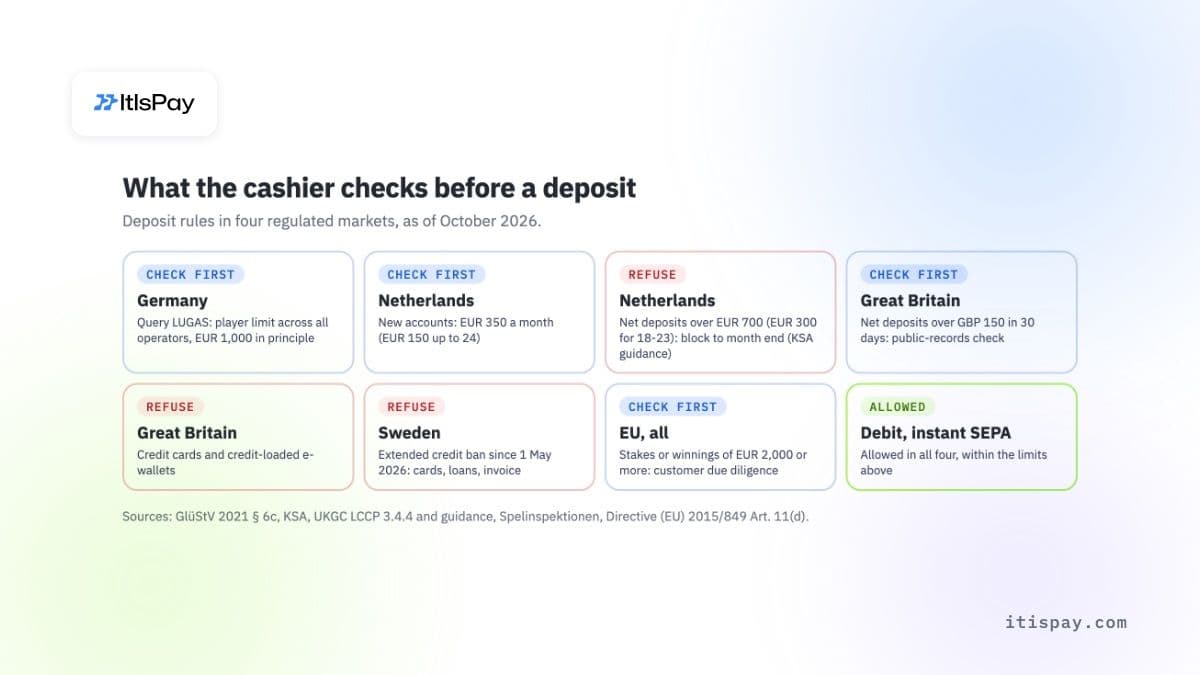
Gambling with credit cards has been banned since 14 April 2020. Licence condition 6.1.2 says the operator must not accept credit card payments for gambling, and the Gambling Commission's guidance asks operators that take e-wallets to make sure the money in the wallet was not loaded from a credit card.
Affordability checks are moving into the payment flow. Since 28 February 2025, an operator must run a light-touch financial vulnerability check (public records such as bankruptcy orders and county court judgments) once a customer's deposits minus withdrawals pass £150 in a rolling 30 days (LCCP 3.4.4). On 7 July 2026 the Commission's board approved enhanced financial risk assessments based on credit reference data. They start with the largest operators. The first stage applies at net deposits above £5,000 in 24 hours for customers aged 25 and over. The start date will be set in the consultation response. In early implementation, the Commission says, no enforcement action will follow a failure to act on an assessment.
Germany#
The State Treaty on Gambling 2021 (GlüStV, § 6c) caps deposits at €1,000 a month per player in principle, counted across all licensed operators together. Before each deposit, the operator sends the player's data and the amount to a central limit file and must refuse the deposit if the limit is used up. A player who raises the limit waits 7 days; a lower limit applies at once.
The file is part of LUGAS, the system managed by the Joint Gambling Authority of the German states (GGL). According to the GGL annual report for 2025, 5.3 million players were registered in it, and on 15 March 2025 an expired certificate stopped new registrations and deposits at legal operators for several hours. Your cashier needs a clear fallback for that case.
The GGL also blocks payments to unlicensed sites. GlüStV § 9 lets it order banks and payment providers to stop processing for illegal gambling. In 2025 it took 1,907 payment-blocking measures, and 38 payment providers stopped serving the sites concerned.
Netherlands and Sweden#
In the Netherlands, since 1 October 2024 the deposit limit a new player must set at sign-up starts at no more than €350 a month for adults and €150 for players up to 24; to go higher they must contact the operator, according to the Kansspelautoriteit (KSA). Under the KSA's 2024 policy rule, which is guidance rather than law, once net deposits pass €700 a month (€300 for 18 to 23), the operator is expected to block further deposits until the month ends unless an income check supports more. The player can still play and withdraw.
Sweden's extended ban on gambling on credit has applied since 1 May 2026, according to Spelinspektionen. Operators may not allow play financed by credit cards, bank loans or invoice payment after play, and online operators are expected to block credit cards.
| Market | Payment rule | What the cashier must do | Since |
|---|---|---|---|
| Great Britain | No credit cards, including credit-loaded e-wallets | Block credit card BINs, check e-wallet funding | 14 April 2020 |
| Great Britain | Check above £150 net deposits in 30 days | Trigger a public-records check | 28 February 2025 |
| Germany | Monthly limit across operators, €1,000 in principle | Query LUGAS before every deposit | GlüStV 2021 |
| Netherlands | €350 / €150 limit for new accounts | Set the limit at registration | 1 October 2024 |
| Netherlands | €700 / €300 net deposit threshold (guidance) | Block deposits until month end unless income supports more | KSA policy rule 2024 |
| Sweden | Extended ban on gambling on credit | Block credit cards, refuse invoice payment | 1 May 2026 |
Why are withdrawals the riskiest part of the stack?#
Withdrawals are where regulators look for payment failures. In a July 2024 blog post, the UK Gambling Commission's chief executive said its contact centre receives about 2,000 complaints a year about withdrawal delays, the most common subject, and that the same issue comes up often in dispute resolution cases.
Two rules apply. Licence condition 17.1.1 says a withdrawal request must not trigger a demand for new information if the operator could reasonably have asked for it earlier. Since 31 October 2021, remote technical standard RTS 14B has banned reverse withdrawals: "Consumers must not be given the option to cancel their withdrawal request." The rules set no fixed payout time. What they forbid is holding up a payout with checks that could have been done earlier.
Enforcement is recent. On 21 October 2026, L & L Europe agreed to pay £900,000 in a settlement with the Commission. Its terms allowed only one pending withdrawal at a time, which the Commission called unfair under the Consumer Rights Act 2015. It also reviewed every fifth or tenth withdrawal by hand and asked for extra information.
The practical rule follows from this: run verification at registration and deposit, and keep the payout path free of checks that could have happened earlier.
How do Visa rules treat iGaming merchants?#
Card acceptance remains open to licensed operators, but Visa's rules make every gambling transaction identifiable and every dispute count. Under the Visa Rules of 18 April 2026 (Product and Service Rules, 5.8.18.1), an online gambling merchant must hold a valid licence or other appropriate authority and mark each transaction with merchant category code (MCC) 7995, even when gambling is not its main business. Winnings paid back to a card must go as an Original Credit Transaction. In Europe they go to the same card that placed the winning bet (rule 5.8.18.3). Funds transfers used to fund gambling must also be marked as gambling (rule 5.8.18.2).
Since 1 June 2025, Visa has measured fraud and disputes with one ratio in its Acquirer Monitoring Program (VAMP): fraud reports plus disputes, divided by settled card-not-present transactions. According to the Visa VAMP fact sheet, a merchant in the EU is "Excessive" at 150 basis points (1.5%) with at least 1,500 fraud and dispute items a month from 1 April 2026, down from 220. For the acquirer, the thresholds are 50 basis points ("Above Standard") and 70 ("Excessive").
Mastercard runs its own chargeback monitoring programmes. Check the current thresholds with your acquirer rather than relying on figures from vendor guides.
Which iGaming payment methods should an EU operator offer?#
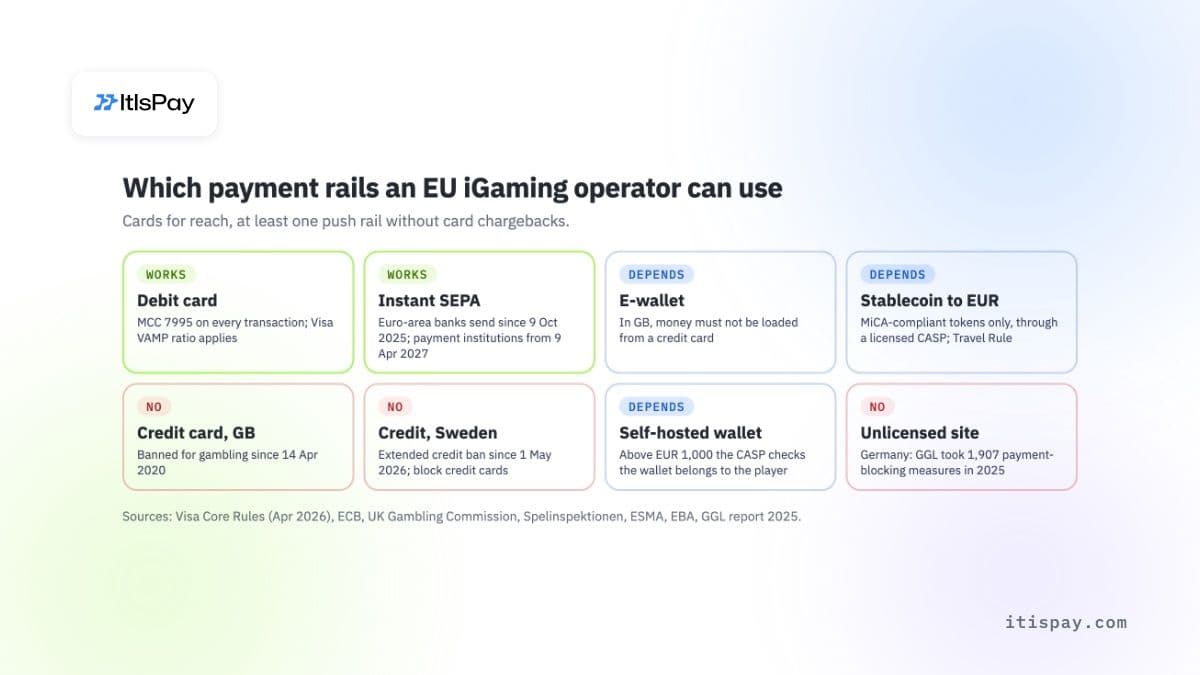
Offer debit cards for reach, and at least one push payment rail, where the player sends the money and no card chargeback exists. Instant SEPA transfers and stablecoins are the two push rails that matter most for EU operators.
The Instant Payments Regulation (EU) 2024/886 has made instant euro transfers standard for banks in the euro area. According to the ECB, banks there have had to receive them since 9 January 2025 and send them since 9 October 2025, at no higher price than a standard transfer and with a free check of the payee's name against the IBAN. Payment and e-money institutions follow on 9 April 2027. Instant SEPA pairs well with virtual IBANs, which let you match each incoming transfer to one player account.
| Method | Deposits | Payouts | Watch out for | Verdict |
|---|---|---|---|---|
| Debit card | Yes | Yes, to the same card (Original Credit Transaction) | MCC 7995, VAMP ratio | Works |
| Credit card | Banned in GB and Sweden | Not applicable | Licence market rules | No |
| E-wallet | Yes | Yes | Credit-loaded wallets in GB | Depends |
| Instant SEPA / pay by bank | Yes | Yes | IBAN name check, PI dates 2027 | Works |
| Stablecoin with EUR settlement | Yes | Yes | MiCA-compliant tokens only, Travel Rule | Depends |
Can a licensed casino accept stablecoins in the EU?#
Yes, if its licence market allows it, the stablecoins are MiCA-compliant and the flow runs through an authorised crypto-asset service provider (CASP). The player pays in a stablecoin, the CASP converts it, and the operator receives euros on its IBAN. There is no card chargeback to fight.
Three rules set the limits. Under MiCA Art. 48, only an issuer authorised as a credit institution or e-money institution, or someone with its written consent, may offer an e-money token (a stablecoin tied to one official currency) to the public in the EU. On 8 October 2026, ESMA said that MiCA-authorised CASPs "should cease providing services related to non-MiCA-compliant stablecoins" for EU clients. Old positions are to be cleared within three months, and the opinion names no token. Since 30 December 2024, the Transfer of Funds Regulation (EU) 2023/1113 has required originator and beneficiary data on crypto transfers. For a transfer above €1,000 from a self-hosted wallet, the CASP must also check that the wallet belongs to its customer, according to EBA guidelines.
The setup for accepting crypto payments automatically is the same for an operator as for any merchant: a payment link or API call, conversion by the CASP, a webhook to your back office.
Where stablecoins do not help
- They do not replace a gambling licence in the player's market, or the market's deposit limits and checks.
- They do not remove KYC: stakes and winnings of €2,000 or more trigger customer due diligence whatever the payment method.
- ESMA's October 2026 opinion tells EU CASPs to stop services for tokens that are not MiCA-compliant.
- Transfers from players' own wallets above €1,000 need a wallet ownership check, which adds a step at the first deposit.
What AML checks apply to deposits and winnings?#
The €2,000 line for gambling stays when the EU's new AML regulation takes over. The Fourth Anti-Money Laundering Directive (EU) 2015/849 already names gambling providers as obliged entities, and Art. 11(d) requires customer due diligence on "the collection of winnings, the wagering of a stake, or both, when carrying out transactions amounting to EUR 2 000 or more", including linked transactions.
The AML Regulation (EU) 2024/1624 applies from 10 July 2027 and keeps the €2,000 threshold for gambling providers, according to AMLA's final report of 30 September 2026. The same report sets out how linked transactions will be judged: a gambling provider will also have to treat games it provides itself as a sign that a player's stakes and winnings are linked. That is a draft standard sent to the European Commission, not yet law.
How do you choose an iGaming payment provider in 2026?#
Judge a provider or iGaming payment gateway by the licence markets it can serve. The number of methods on its website tells you little. Before you sign, check six things:
- Per market, the provider can show you which methods it blocks and which checks it runs: credit cards in GB and Sweden, LUGAS in Germany, KSA limits in the Netherlands.
- In Germany, the cashier queries LUGAS before each deposit and has a tested fallback for an outage like the one in March 2025.
- Withdrawals go out without new document requests and without a cancel button, and you can see the status of each payout.
- You get your VAMP ratio from the acquirer each month, and a second acquirer is ready if the first one drops gambling.
- At least one rail has no card chargebacks: instant SEPA, MiCA-compliant stablecoins with EUR settlement, or both.
- Every deposit and payout, on every rail, ties back to one player account and one ledger.
If your main issue is getting a high risk merchant account at all, start there. This guide to iGaming payment solutions assumes you already hold a gambling licence.
If card acquirers keep declining or freezing your gambling traffic, stablecoins are a payment channel without chargebacks. ItisPay provides the API, invoicing and reconciliation, and settlement to EUR runs through our EU-licensed CASP + Payment Institution partner. We work with high-risk merchants, including iGaming: each business is reviewed individually, and onboarding depends on approval by our licensed partners. We do not take weapons, adult content or nutraceuticals.
This article is for informational purposes only and does not constitute legal or regulatory advice.