Binance says the Abu Dhabi Global Market (ADGM) Courts have granted it a worldwide freezing order covering $6.5bn against the unknown people behind its hack of 29 October. The Binance freezing order does not bring a coin back on its own: it gives issuers and exchanges that already hold frozen funds the court order some of them require before they release anything, and it puts about 26,000 wallet addresses on a list the market is asked to watch.
For a bank that holds crypto for clients, the more useful lesson sits a step earlier. Binance held its own keys, and the attackers still emptied most of its hot wallets in about 20 minutes. Courts and stablecoin issuers can stop part of the damage afterwards. What leaves the wallet in the first place is decided by the bank's own signing rules.
Data in this article is as of 18 November 2026, evening UTC. Figures are still changing.
Key moments
In short
- The ADGM Courts order covers $6.5bn and targets the unidentified attackers; it adds proprietary injunctions and delivery-up orders over specific stolen assets (The Block, 18 November 2026).
- Of about $6.34bn affected, Binance says about $2.85bn has been frozen or intercepted; the US Justice Department has court authority to seize or restrain more than $1.2bn of the frozen funds (12 November 2026).
- In early November, Elliptic estimated that about $3.3bn sat in bitcoin, ether and XRP, which no issuer can freeze.
- For banks: an order works after the theft. Limits, an independent second signer, an address allowlist and cold storage work before it.
What did the Binance freezing order actually do?#
The order restrains the people behind the attack from dealing with up to $6.5bn of assets, wherever those assets are. According to The Block's report of 18 November (published 19:40 UTC), Justice William Stone SBS KC made the order against unidentified persons accused of carrying out the 29 October hack. Binance shared its statement with The Block. We could not find the statement on Binance's own channels, and the order is not listed on the ADGM Courts judgments page as of the evening of 18 November.
The worldwide freezing order is only part of the package. The court also granted interim orders over specific stolen assets and orders requiring those assets to be handed over. Some of the interim orders name parties that have already frozen stolen funds. Binance says it does not allege any wrongdoing by them.
The orders can be served through the blockchain, Binance says, meaning notice reaches the wallets themselves rather than a postal address. And the market will be told of a "living list" of 26,000 wallet addresses that hold stolen assets, updated as the funds move. M. Kendall Day of Gibson Dunn, Binance's law firm, called the injunction "one of, if not the, largest publicly known freezing orders ever made."
The $6.5bn is the limit of the order, slightly above the $6.34bn Binance says was affected. Neither Binance nor The Block explained the gap. It is not an amount frozen or recovered.
Binance hack recovery timeline in UTC#
The recovery has run on three tracks: stablecoin issuers froze funds in the first hour, US prosecutors took court authority over part of them two weeks later, and Binance has now added a civil order in Abu Dhabi. The table gives the steps we could confirm. The hack itself is covered in detail in our article on the Binance hack of 29 October.
| Date and time (UTC) | Event | Source |
|---|---|---|
| 29 Oct, from 20:05 | Hot wallets drained across ten blockchains, most of it within about 20 minutes | TRM Labs |
| 29 Oct, 21:01 and 21:04 | Tether freezes USDT, Circle freezes USDC | TRM Labs |
| 1 Nov, 06:00 | Withdrawals restart on the first 15 networks and assets | Binance on X, via ZeroHedge |
| 12 Nov | DOJ announces court-authorised seizure and restraint of more than $1.2bn | US Justice Department |
| 14 Nov | Binance says 87 more networks reopened that week; aims to reopen the rest by the end of the following week | Binance on X, via ZeroHedge |
| 18 Nov, story at 19:40 | Binance reports the $6.5bn ADGM Courts order | The Block |
In the first nine and a half hours after the 1 November restart, customers withdrew $4.6bn and deposited $1bn, a net outflow of 2.1% of the exchange's assets, by Binance's count. As of 18 November, we found no confirmation that every network has reopened.
How much is frozen, and how much can no one freeze?#
Less than half of the stolen value is frozen, and frozen does not mean returned. Binance says about $2.85bn of roughly $6.34bn has been frozen or intercepted. The US Justice Department release of 12 November gives a similar figure: US government and private-sector efforts "have resulted in the freeze of more than $2.7 billion", and the department has court authorisation "to seize or restrain in excess of $1.2 billion of that amount."
The rest is harder. In early November, Tom Robinson, co-founder of Elliptic, told The Block that about $3.3bn remained in bitcoin, ether and XRP, "which no one can freeze." These assets have no issuer with a freeze button. They can be stopped only when they reach an exchange or service that cooperates.
Binance has said customers will not carry the loss. It replaced most of the stolen assets from its Secure Asset Fund for Users (SAFU), its insurance fund and its corporate treasury. So the recovery effort now restores Binance's own balance sheet, not client balances.
Why does Binance need a court order to get funds back?#
Because a freeze stops movement but does not decide ownership. When Tether or Circle freezes an address, the tokens stay where they are. To reissue them to Binance, an issuer wants proof that Binance is the rightful owner. Robinson said in early November that issuers would first want "a clear legal basis", such as a law enforcement request or a court order, and that this could take weeks or months. Binance's own statement says some issuers, exchanges and other partners require a court order before they release or return frozen funds.
The three kinds of order do different jobs:
- A worldwide freezing order is a personal order against the attackers not to deal with their assets up to the limit. It transfers nothing. Third parties who receive notice of it can be in contempt if they help breach it.
- A proprietary injunction covers specific assets that the claimant says are its own property, here identified stolen tokens.
- A delivery-up order requires specific assets to be handed back.
ADGM Courts work on English common law, and they have granted worldwide freezing orders before: the ADGM Court of Appeal granted one of up to $250m in December 2025. Service through the blockchain also has precedent outside Abu Dhabi: the English High Court allowed service on persons unknown by NFT in D'Aloia v Persons Unknown (2022), after a New York court did so in LCX AG v John Does (2022). We found no ADGM ruling on blockchain service; the description of how these orders will be served comes from Binance and Gibson Dunn only.
A court in Abu Dhabi cannot reach a bitcoin address held by an attacker who never appears, never uses a cooperating exchange and ignores the order. The order helps where funds pass through someone who wants to obey it. For a bank, that someone could be you.
Where reporting on the Binance freezing order goes wrong#
Several reports blur facts that matter to a risk team.
- "Binance freezes $6.5bn" or "recovers $6.5bn" is wrong. The $6.5bn is the limit of the order. Frozen value is about $2.7bn to $2.85bn, depending on whose count you use.
- Reuters-based pieces describe ADGM as Binance's main financial regulator. The ADGM regulator is the Financial Services Regulatory Authority. The order came from the ADGM Courts, a separate judicial body. A regulator did not freeze anything.
- "Binance has not said how much the order covers" was true of the first Reuters report. The Block later published the $6.5bn from Binance's statement.
- "US seized $1.2bn" overstates it. The DOJ release says "court-authorized seizure and restraint" of more than $1.2bn, part of funds already frozen. No public forfeiture ruling has decided who gets them.
- Some outlets in Asia date the story 19 November, local time. The Block published it at 19:40 UTC on 18 November.
How did attackers reach Binance's signing systems?#
Through people, not through a stolen key. Binance's initial findings, as reported by ZeroHedge, describe a five-month campaign. In June, an engineer on the wallet team installed a tampered developer tool. In September, a second engineer was approached on a job platform by a "Project Director" of a company that did not exist and was asked to download a coding "assignment" carrying malware. On 20 October the attackers used an internal AI tool to take over the machines of two wallet developers. On 29 October they used stolen credentials to run a malicious script against the wallet systems and empty the hot wallets.
On 29 October Binance had said it found no evidence of a private key leak. Both statements can be true. The attackers did not need the keys; they needed a way to make the signing system approve transfers. Binance has promised a full incident report and has not published it yet, so its exact signing rules remain unknown.
So Binance is not a case of "they gave their keys to someone else". It held its own keys. The question for a bank is what its signing path does when valid credentials ask it to send the whole hot balance in one go.
How do banks set signing rules for client crypto?#
Banks and large neobanks publish little about their crypto controls. Their own documents still show three models.
BBVA: keys on the bank's own platform#
BBVA completed its MiCA notification with Spain's CNMV and says it "will utilize its own cryptographic key custody platform", keeping full control over safeguarding client crypto "without relying on third parties" (BBVA press release, 10 March 2025). This is the route MiCA Article 60 opens for credit institutions, which we describe in crypto custody for banks under MiCA. BBVA does not publish its approval rules or its hot and cold split.
Revolut: a quorum for policy changes and an allowlist#
Revolut Digital Assets Europe publishes a client asset safeguarding policy. Its own-custody part runs on a multi-party computation (MPC) wallet, where Revolut holds most of the key shares. Amendments to the transaction authorisation policy need "a quorum of at least two approvals", accounts used for crypto transfers go through whitelisting with maker and checker approval, and "the majority of client crypto assets are kept on cold wallets."
Bitpanda: a licensed custodian with multi-level approval#
Bitpanda, a MiCA licence holder, says in its custody policy summary that client assets sit in "a combination of hot and cold wallets, with a strong emphasis on using cold wallets for long-term storage." It names "multi-signature wallets" and "multi-level authorisation procedures" for transfers. A bank that uses a licensed custodian hands the signing rules to that custodian and checks them through due diligence. Our guide to digital asset custody covers that model.
MiCA Article 75(3) requires a custody policy that minimises the risk of loss "due to fraud, cyber threats or negligence." It does not prescribe how many signers you need. That choice is yours.
Own custody with signing rules vs other options#
The table compares four arrangements a bank can choose for client crypto, judged on one test: could a Binance-type attack, with valid staff credentials, empty the wallet before anyone stops it?
| Arrangement | Who signs | Stops a mass transfer made with stolen staff credentials? | Verdict |
|---|---|---|---|
| Client balances held at an exchange | The exchange | Not in your control | No |
| Licensed third-party custodian | The custodian, under its policy | Yes if its policy has limits and independent approval; check in due diligence | Depends |
| Own custody, keys in-house, no hard rules | Your wallet service | No: whoever drives the service can drain it | No |
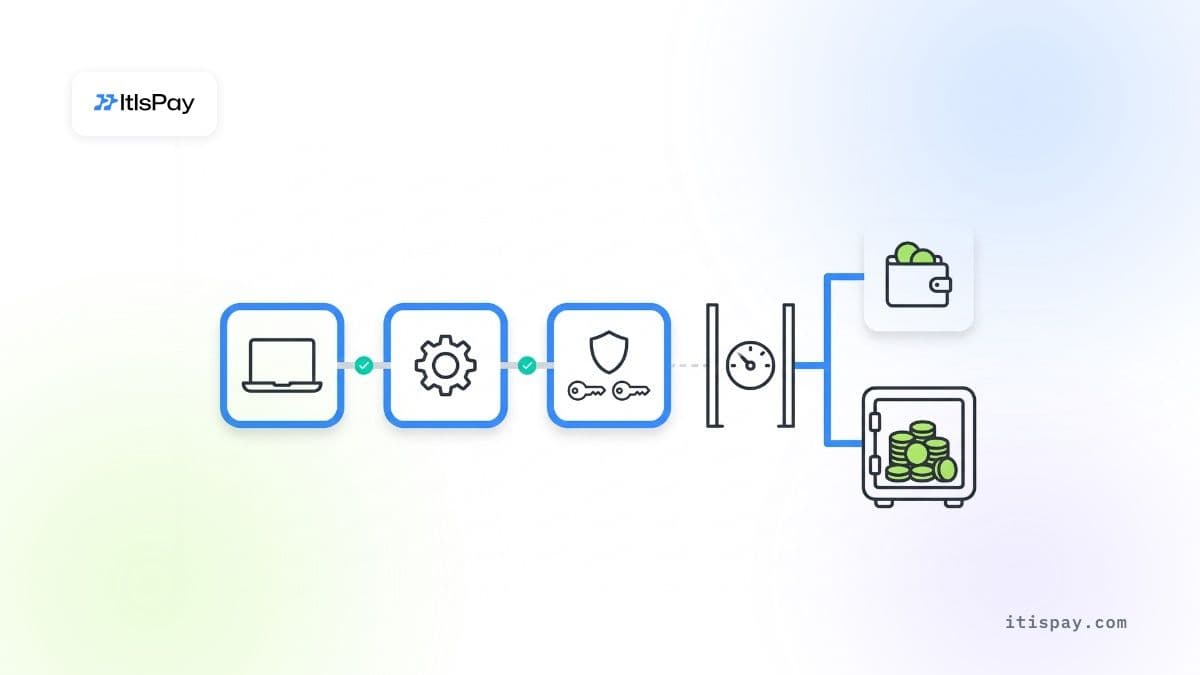
| Own custody with signing rules | Your service plus an independent approver | Yes: hourly caps, second signer outside the service, allowlist, most assets cold | Works |
None of the rules in the last row is new. A hot wallet holds only what a day of withdrawals needs. A per-hour cap stops a 20-minute drain at the cap. The second approval comes from a person or device that the wallet engineers cannot control. New addresses wait before first use. A freeze switch lets compliance stop one client or one address without stopping the whole bank.
Where signing rules do not help
- Collusion between the people who hold both approvals.
- A compromised policy engine: if attackers can rewrite the rules, the rules fail. Changes to the policy itself need their own quorum.
- Bitcoin or ether that has already left: no rule recalls it, and no issuer can freeze it.
- A court order binds only those who receive it and choose to obey it.
What should a bank check this week?#
The Binance freezing order creates two duties for anyone that receives crypto. Start with those, then test your own signing path.
- Screen against the living list. Load the 26,000 addresses into your blockchain analytics as Binance publishes them, and check deposits received since 29 October. A match means a frozen balance and a report, not a quiet refund.
- Test a freeze on one client. Can compliance freeze a single address or balance, and hand assets back on a court order, without stopping all withdrawals? Time it.
- Check self-hosted wallet rules. Under the EU Transfer of Funds Regulation, Articles 14(5) and 16(2), transfers above EUR 1,000 to or from a self-hosted address require adequate measures to assess whether the client owns or controls it.
- Find the second signer. Is the final approval outside the service that builds the transaction, and outside the reach of the wallet engineers?
- Set hourly caps. What is the most that can leave the hot wallet in one hour, and who can lift the cap?
- Count the hot share. What share of client crypto is online today, against what one day of withdrawals needs?
- Review hiring and tooling risk. Fake recruiters and tampered developer tools were the way in here. Wallet engineers need managed devices and a rule against running outside code on work machines.
Software for crypto inside the bank's perimeter#
Banks and PSPs use ItisPay to add crypto acceptance for their merchants as a new payment channel. The platform installs inside the bank's own infrastructure, so data and logs stay in its perimeter, staff access follows the four-eyes rule, and the bank receives the source code. Keys to customer funds sit with our EU-licensed CASP + Payment Institution partner, which also handles licensing, KYC and settlement in EUR.
This article is for informational purposes only and does not constitute legal or regulatory advice.