

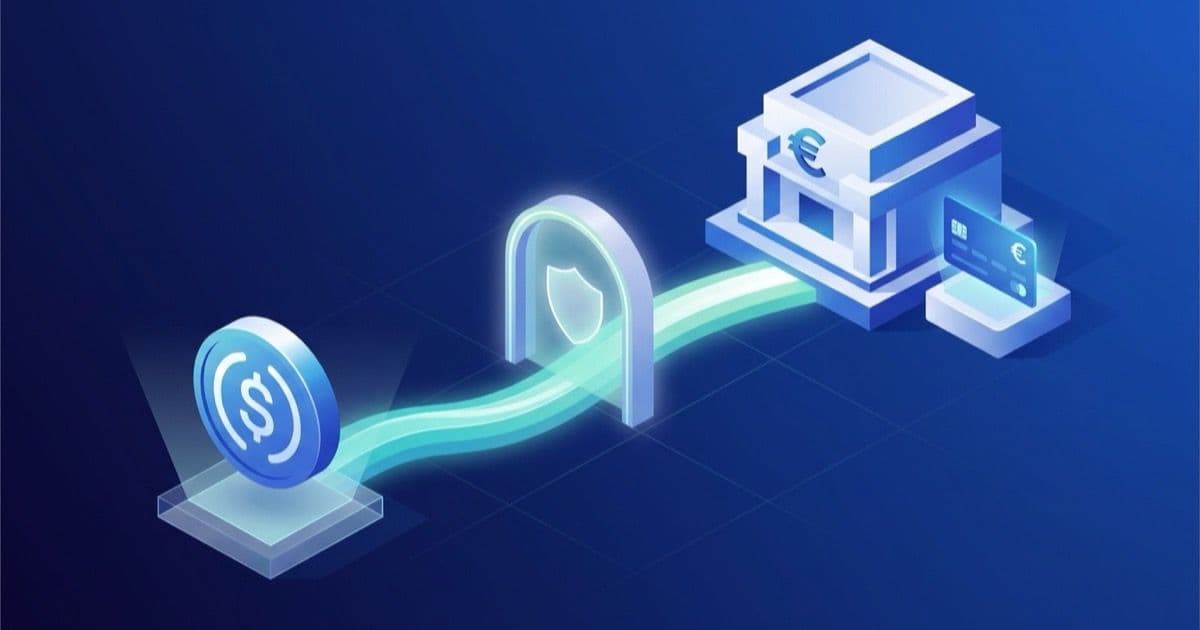
A customer pays 5,000 USDC on Friday, and your payroll runs in euros on Monday. A crypto to fiat payment gateway sits between those two facts, and since 1 July 2026 the choice of gateway matters more in the EU than its fee.
This guide is for businesses that already have customers willing to pay in crypto and need the money in a bank account, in EUR, without holding coins or building a compliance team. It covers what the gateway does, who needs the licence, which stablecoins still convert in the EU, what the Travel Rule asks at checkout, and what the whole thing costs compared with cards.
What a crypto-to-fiat gateway actually does#
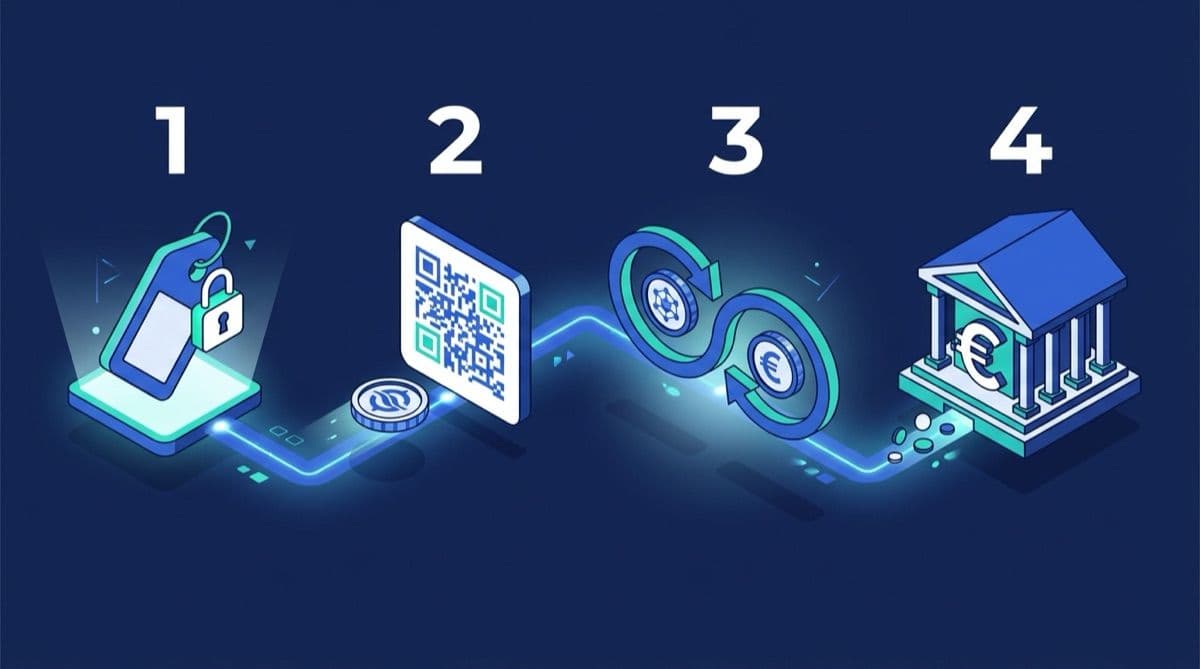
A crypto-to-fiat gateway turns a customer's crypto payment into euros on your bank account. It does four things in sequence: it quotes a price and locks the exchange rate, gives the customer an address to pay, converts the coins once they arrive, and sends EUR to your IBAN. You see an invoice marked paid; the customer sees a normal checkout. Each of the four steps has its own delay and its own place where cost can hide, so comparing gateways by a single headline percentage misses most of the picture. The step that decides how fast you actually have the money is the last one: the bank transfer. Since 2025, euro-area banks must be able to send SEPA Instant payments, which land in 10 seconds, but not every gateway pays out that way.
| Step | What happens | Typical time | Where cost hides |
|---|---|---|---|
| 1. Quote | Gateway shows the amount in crypto and locks a rate for a short window | At checkout | Rate margin built into the quote |
| 2. Receive | Customer sends coins to a one-time address | Seconds to minutes, depends on the network | Network fee, paid from the sender's wallet |
| 3. Convert | Gateway sells the coins for EUR | Usually within minutes | Conversion fee and spread |
| 4. Pay out | EUR goes to your IBAN | 10 seconds (SEPA Instant) to the next business day (standard SEPA) | Payout fee, minimum payout amounts |
If you want the merchant side of the setup in more detail, we cover how to accept crypto payments step by step in a separate guide.
Who needs the licence: you or the gateway#
In most cases the gateway needs the licence and you do not. The Markets in Crypto-Assets Regulation (MiCA) licenses crypto-asset services provided to clients: custody on behalf of clients, exchanging crypto for money, transferring crypto on behalf of clients and similar services, listed in Article 3(1)(16). Article 59(1) says a person "shall not provide crypto-asset services, within the Union" unless it is authorised as a crypto-asset service provider (CASP) or is a listed financial entity. A business that sells its own goods, takes payment in crypto and converts it through a licensed provider is not offering any of those services to anyone. The gateway is. This is a reading of the regulation's definitions rather than a sentence from a regulator, so check it with your own counsel if your model is unusual.
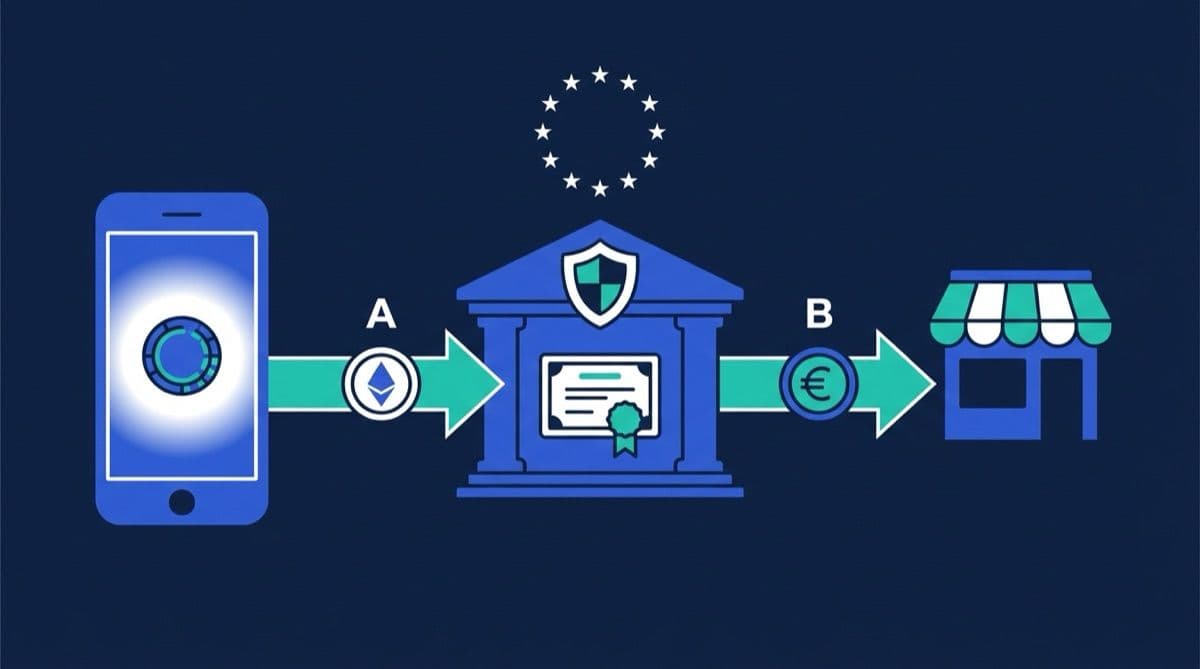
What changed this year is the gateway's side. Firms that were already operating under national rules could keep serving clients during a transition, but Article 143(3) of MiCA set the end date: they may continue "until 1 July 2026 or until they are granted or refused an authorisation". That date has passed. An unlicensed gateway is no longer allowed to serve EU clients, and if it is shut down or forced to stop, your payments stop with it.
Getting a licence is not a small step for the gateway either. MiCA's Annex IV sets minimum capital of EUR 50,000, EUR 125,000 or EUR 150,000 depending on the class of services, or a quarter of its fixed overheads if that is higher (Article 67), and a gateway that exchanges crypto for money falls at least into the EUR 125,000 class. Add a compliance officer, policies, ICT controls and a review by the national regulator, and the cost of doing it in-house runs well beyond the capital floor. That is why most businesses that accept crypto do not apply for a MiCA CASP license themselves; they route payments through someone who already has one.
What this means in practice#
Your obligations do not disappear. You still keep records of what you sold, account for the euro value of each payment, and answer your provider's questions about your business when you sign up (KYB, know your business). What you avoid is the licence, the capital and the regulator's review. The risk you take on instead is counterparty risk: whether the provider you picked is licensed and stays licensed.
How to check a gateway before you sign#
Check two authorisations, not one. The first is MiCA authorisation as a CASP, which covers receiving, converting and transferring crypto. The second matters if the gateway handles stablecoins that qualify as e-money tokens, such as USDC or EURC, as payments: the European Banking Authority has said that transferring or holding such tokens for clients can also be a payment service under PSD2, the Payment Services Directive. In a no-action letter published in June 2025, the EBA gave CASPs a transition until 2 March 2026 to obtain that second licence. A gateway that shows both numbers, a CASP authorisation and a payment or e-money institution licence, is easier to rely on than one that says "MiCA-ready".
Before you sign, ask for and verify:
- the gateway's entry in ESMA's register of authorised CASPs, and the name of the legal entity that will contract with you;
- the home regulator and licence number, checked on the regulator's own website;
- its payment or e-money institution licence, if it settles stablecoin payments;
- which coins it converts to EUR inside the EU;
- whether payouts go by SEPA Instant, and what minimum payout amount applies;
- how refunds work and in which currency they are paid.
ESMA's interim MiCA register listed more than 360 authorised CASPs on 7 October 2026, so a licensed provider is not hard to find. The name on the contract should match the name in the register.
Which stablecoins settle to EUR in the EU#
USDC and euro stablecoins such as EURC convert to EUR through EU-licensed providers. USDT is a different case. Under MiCA, a stablecoin that references a single currency is an e-money token, and only an authorised credit institution or e-money institution may offer it to the public (Article 48). Tether has no such authorisation. In January 2025 ESMA told CASPs to stop services in non-compliant stablecoins, allowing "sell only" until the end of the first quarter of 2025, while noting that "mere custody and transfer of these crypto-assets should remain possible". Binance, Crypto.com, Coinbase and Kraken removed USDT for EEA users. Circle, the issuer of USDC, obtained an e-money licence in France in July 2024, which is why USDC kept its place.
This matters because USDT still dominates the market. The ECB's November 2025 Financial Stability Review put USDT at 63% of the stablecoin market and USDC at 26%. Some of your customers will want to pay in USDT; an EU-licensed gateway will usually not convert it for you.
ESMA's executive director Natasha Cazenave described the result in April 2025: the statement "led to the de-listing of prominent stablecoins by major EU exchanges, which is a sign that the industry is adjusting." Euro stablecoins are growing from a small base. Chainalysis measured EURC growth of 2,727% between July 2024 and June 2025, against 86% for USDC.
The Travel Rule at checkout: what customers see#
The Travel Rule is mostly the gateway's job, but your customer will notice it. Regulation (EU) 2023/1113, which applies since 30 December 2024, requires a CASP sending crypto to pass on information about the sender, and the CASP receiving it to obtain that information. There is no minimum amount for crypto transfers. When a payment comes from a personal wallet that no exchange controls, the receiving CASP still has to "obtain and hold" the sender's details (Article 16(2)), so a customer paying from such a wallet may be asked for their name and other information before the payment is credited. Above EUR 1,000 the rules add further checks on self-hosted addresses. Tell B2B clients this before they pay, so a request for details does not look like a failed payment.
What it really costs compared with cards#
The claim that crypto is "cheaper than cards" holds only if you compare the full bills. On the card side, EU rules cap interchange, the fee paid to the cardholder's bank, at 0.2% for consumer debit cards and 0.3% for consumer credit cards (Regulation (EU) 2015/751). That cap is only one line. A European Commission study found that the scheme fees charged by card schemes on top of interchange almost doubled between 2018 and 2022, from 0.27% to 0.44% of the transaction value. Commercial cards are not capped; in the Commission's 2020 review, interchange on them averaged about 0.86% and the total cost to the merchant about 1.20% (2017 data). Then there is the acquirer's own margin, chargebacks, and the cost of disputes.
On the crypto side, gateways publish their own figures: CoinGate states fees "starting from 1%", and CryptoProcessing advertises "<1.5%". We found no independent study of crypto acceptance costs in the EU, so treat those numbers as marketing until you see a quote. Ask what the percentage includes.
| Cost line | Cards (EU) | Crypto to EUR via a gateway |
|---|---|---|
| Fee to the payer's side | Interchange capped at 0.2% (debit) / 0.3% (credit); commercial cards uncapped | Network fee, paid from the sender's wallet |
| Scheme or network fees | 0.44% on average (2022, EC study) | None |
| Processor fee | Acquirer margin, negotiated | Gateway fee, around 1–1.5% by companies' own claims |
| Exchange-rate cost | None for EUR cards | Spread inside the quote, often not shown separately |
| Payout to your account | Acquirer settlement schedule | Payout fee or minimum amount, varies |
| Chargebacks | Yes, with fees and disputes | No chargebacks; refunds are a manual decision |
For many businesses the useful question is not "which is cheaper" but "which customers would not pay at all without crypto". If you already route card traffic across several providers, crypto can be added as one more route in your payment orchestration setup rather than as a separate system.
How fast the euros reach your bank account#
Conversion usually takes minutes at most; the bank leg decides when you can spend the money. Under the Instant Payments Regulation (Regulation (EU) 2024/886), the receiving bank must make an instant transfer available "within 10 seconds", 24 hours a day, every day. Euro-area banks had to be able to send instant transfers by 9 October 2025, while payment and e-money institutions in the euro area have until 9 April 2027. A standard SEPA transfer reaches the payee's bank by the end of the next business day. Ask the gateway which rail it uses and whether payouts are automatic or batched, and check that euros land on an account in your company's name, such as a named virtual IBAN.
Risks that stay with the business#
Converting to EUR at the moment of payment removes price risk; holding crypto brings it back. ESMA noted that crypto-assets lost more than 20% of their value in the first quarter of 2025 alone. Stablecoins reduce that risk but do not remove it: the ECB warns that their "primary vulnerability is that investors lose confidence that they can be redeemed at par", which can trigger a run and a loss of the peg. ESMA's Natasha Cazenave put it plainly in April 2025: "despite MiCA, there will be no such thing as a safe crypto-asset."
Two practical steps cover most of this. Settle to EUR automatically rather than holding balances. Agree in your terms in which currency refunds are paid and who carries the exchange-rate difference, because crypto payments have no chargeback mechanism to fall back on.
If you want to accept stablecoins and receive euros without building the stack yourself, ItisPay provides the API, invoicing and reconciliation. Licensing, KYC and settlement to your IBAN run through our EU-licensed CASP + Payment Institution partner, and most teams go from KYB to first transaction in under a week.
This article is for informational purposes only and does not constitute legal or regulatory advice.

